Powered by Blogger.
Showing posts with label Mount Road. Show all posts

Wednesday, 1 June 2011

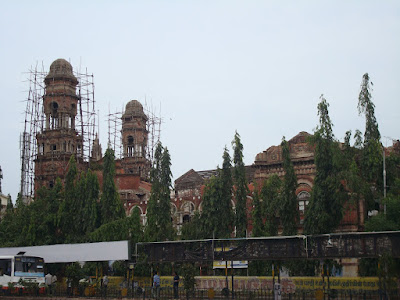
Under (re)construction

This is not a new building, for sure. The Bharat Insurance Building has been around for as long as I can remember. In fact, it has been around for so long that it is not being used anymore. But do you see those towers in the background, with scaffolding around them? 

That's because they belong to a much, much older era. They were part of the Kardyl Building, which was inaugurated in 1897. In the course of their long life, they have weathered much, but the sheer neglect of the past fifteen years or so pushed them to the brink of ruin. In August 2006, the Madras High Court restrained the Life Insurance Corporation of India, the current owners of the building from "demolition or change in character" of the building, thanks to the efforts of Chennai's minuscule but valiant heritage lobby. Since then, an agreement appears to have been arrived at. There is some restoration activity going on at this building. One hopes that it will go back to the bubbling spirit it had in the days when it housed a soda-water bottling plant and a beer parlour on the premises!


It is 'Theme Day', over at www.citydailyphoto.com! Go over there to find photos from around the world on the theme 'construction'!!

Wednesday, 25 May 2011

Outward looking

Before this building came up on Mount Road, the space was the front lawns of Spencer's Hotel. Though they had sold the entire property to M.Ct.M Chidambaram Chettiar's family sometime around 1944, Spencer's continued to run the hotel into the early '50s. Even for many years after, that hotel building continued to be in use, as the training centre of the Indian Overseas Bank, who had by then raised their headquarters building on the hotel gardens. 

The Indian Overseas Bank was the second of the 'local' banks to be established in Madras, in 1937. As was the case with almost every business venture of the time, it began life in George Town. Chidambaram Chettiar realized that with several restrictions on foreign exchange business being placed upon banks after the Great Depression, Indian businessmen trading overseas would welcome an 'Indian' bank for their exchange transactions. And so was born the Indian Overseas Bank - that middle word establishing its market intent and to distinguish it from 'Indian Bank', which predated it. To prove that intent, the bank opened its overseas branches, in Rangoon (now Yangon) and Penang within a few months of opening their first offices in Karaikudi and Madras. 

It was M.Ct.M Chidambaram Chettiar's desire to have a skyscraper on Mount Road that saw him first go to work on the LIC Building, in 1953. But he died in 1954, before the building was completed - and before the insurance business was nationalized in 1956. His sons Pethachi and Muthiah fulfilled their father's wish - the design of this building also drawing inspiration from the UN Headquarters. This building also went into the Government's hands soon after - banking nationalization coming through in the late 1960s. Yet, a statue of M.Ct.M Chidambaram Chettiar's statue stands outside this building, which has been the headquarters of the IOB since 1964. Hopefully it will also participate in the platinum jubilee celebrations on February 10, 2012!


Sunday, 22 May 2011

On the bridge

Not as often used as the Central Station or the LIC Building, but this view of the Raja Annamalai Memorial Hall and Rani Seethai Hall is also an instant identification of the city.


From the top of the Gemini flyover...


Saturday, 7 May 2011

Finest store

Why did so many Gujarati traders come down to Madras during the middle of the 19th century? It must have had something to do with their relationship with the English, who had set up their first trading post in the sub-continent at Surat, for sure. Among the later arrivals was Poppat Jamal, who came in to the city as an apprentice to Ibrahim Peer Mohammed & Co., dealers in fine glassware and china. He did well, for when the founders decided to sell out of the business, it was Poppat Jamal they handed it over to, in 1901.

Ever since then, the establishment in Chennai has been called Poppat Jamal & Sons, even though the branches in Kochi, Bengaluru and Vijayawada have been re-branded as Jamal's. It is quite likely the ownership has become fragmented and there are several of these "finest store of its kind in India" in all these cities!


Tuesday, 4 January 2011

Open gates

We used to call it the 'Electricity Road', or the 'TNEB Road', because there was a Tamil Nadu Electricity Board office somewhere along this stretch of road. It was probably a private road in those days, with the barriers on the Commander-in-Chief Road (now Ethiraj Salai) / Binny Road side being almost always closed. With the barriers shut, even with their high clearance, it was rather daunting prospect to ride a bike down this road. If they were open, it was always a good excuse.

Over time, we found the barriers were not closed as often as they once were. This road became a familiar path to avoid the traffic along Anna Salai, zipping over from Binny's Road to Dam's Road, bypassing the traffic and the lights. The stench of the Cooum was a relatively small price to pay, for this road runs along the eastern bank of the river where it runs parallel to Mount Road, coming from behind Spencer Plaza.

These days, the barriers never seem to be shut. The road still does not seem to be a thoroughfare - maybe there is still a feeling of impropriety in using it. And the road itself continues to be anonymous. Without any proper name, it shows up as 'Link Road' on most of the maps!


Tuesday, 9 November 2010

Famous food

The sign seems to be out to confuse you. Yes, of course that's a sardar welcoming you in, but the board says "Vellore". Check as many times as you like, but you'll not find any evidence of Vellore being anywhere near the land of the five rivers. And yet, that's what the sign goes on to imply. Also, I am sure there are sardars who are pure vegetarians, but I haven't come across one in all these years.

Eliminating the impossibles, this is what I'm left with. Sardar landed up in Vellore many many moons ago. Vellore, in case you didn't know, is a major clearing house for kuska - that is biriyani without pieces of anything. That probably drove home the point that vegetarianism is good business; and so sardar mixed the exotic "Punjabi Dhaba" with the blandness of Vellore cuisine, added in the "Gyan Vaishnav" for good measure and voila! Vellore Punjabi Dhaba became famous.

Actually, it became famous enough that it brought the Vellore Gyan Vaishnav brand to Chennai. Famous enough for the Chennai branch to be inaugurated by Amitabh Bachhan. For all that, it remains fairly rooted to the essence of the dhaba: simple food, quick service, easy on the wallet. No wonder that the sardar from Vellore has hundreds, maybe thousands, of die-hard fans in Chennai!


Wednesday, 25 August 2010

Not just the mall!

Even an occasional visitor to Chennai can easily identify this as the Spencer's junction. Once upon a long time ago, this was the site of a handsome, redbrick building with a sweeping driveway. Spencer & Co., the original department store of Madras gave way to the current buildings after it was destroyed by a fire. A replica of the original facade can be seen at Phase III of Spencer Plaza, the largest of the buildings in this cluster.

The most visible part of the cluster is the shopping mall. It is quite likely that a large majority of the visitors to the mall do not even register the fact that there is much more to these buildings - in fact, the office space here is more than the area covered by the mall, because, while there are only three floors of the mall, offices are spread out over seven; and then there is the third building in the cluster.

It was only over the past couple of years that I've come to recognize that building as 'Dewa Towers'. And the style of writing those words (you can see it when you click on the photo) seems rather similar to that of the Dubai Electricity and Water Authority - that's another Dewa!


Monday, 14 June 2010

The Eater's Digest - 8

The concept, they say, is to "Eat as you like, pay as you feel". Such a path-breaking concept had to emerge from a non-business mind, and that's exactly where the Annalakshmi vegetarian dining experince came from. Swami Shantananda Saraswati first put this idea into operation at Kuala Lumpur, Malaysia, in 1984, before bringing it to Chennai in 1986.

There are no specialized chefs, standardized recipes or secret sauces at Annalakshmi. The food is cooked - and brought to your table - mainly by volunteers who give their time to serve the hungry. When it first opened in Madras, Annalakshmi's patrons were taken aback to find senior civil servants, musicians and other well-known public figures taking their orders and bringing the dishes to their table. That's how it has been in the Annalakshmi restaurants all over the world, across Malaysia, Singapore, Australia or India. It was an experience like no other and then, to top it all, there was no bill at the end of it. Remember, the concept is to "...pay as you feel". Of course, given the philosophy and the ambience, it is quite likely one would end up paying just that little more than the 'Management' would have charged.

I have only admired it from a distance, never having the experience of dining there. Maybe it is the 'vegetarian only' menu, but more likely it is the feeling that I will embarass myself by becoming the first person to underpay at this 'Temple of Service'!

Sunday, 16 May 2010

Grease to silk

In the first few years of the 20th century, the then decade-old Anjuman-e-Himayath-e-Islam (AHI) wanted a building where the orphan children from around the vicinity of the Wallajah Mosque could be trained in some trade or the other. For this purpose, they built this red-sandstone structure, where the lower level was the training centre-cum-workshop and the truly indigent students were housed on the upper floor. In the 1930s, the AHI, guided by Justice Basheer Ahmad Sayeed, acquired a much larger parcel of land; by 1947, they had moved out of this building.

Enter the Mahtanis. Most likely as a consequence of partition, young Gobind Mahtani reached Madras from Hyderabad (Sind, Pakistan), to join his uncle. With the additional management bandwidth, the Mahtanis moved their small silk garments business to these premises, taking over the entire ground floor. The first floor was then taken up by India Coffee House. Maybe it was the coffee, maybe it was the clothes - the building became a meeting place for the men-about-town, who would pick up their clothes at India Silk House and then saunter up to the India Coffee House for a cuppa, and much conversation. When the Coffee Board decided to close down the Madras outlet of the India Coffee House, the Mahtanis were ready to expand and they took over the vacant space to start their furnishings division.

Today, this landmark is tucked away in a crook of Mount Road's curve; one hopes the Mahtanis are able to hold on to this heritage structure against the onslaught of all kinds of modernisation happening on Mount Road!

Thursday, 25 March 2010

Rare, very rare

Can't think of too many 'theme' restaurants in Chennai; Sparky's Diner may be one only because there is no other diner, there are (were?) a couple of movie-themed restaurants a while ago, but the list more or less ends there.

And yes, there was (is?) the Rainforest in Adayar where the sounds of thunder and rain were supposedly more exciting than the food. The Cave, which opened about 6 months ago on Mount Road seems to be from the same folks who came up with Rainforest. Themed as a pre-Stone Age eatery, it certainly let's you know that right at the entrance - the gorilla and assorted monkeys sharing cliff-space with what's meant to be a stone age man. It seems to be that they've got the food part better this time around.

I prefer my meat very well done, though!


Tuesday, 16 March 2010

Breaking the pattern

The otherwise regular pattern of buildings along Mount Road is broken by this facade opposite the LIC building. Must say the building is rather photogenic, it certainly looks better in the picture than it does in reality - does startle you for a moment when you see it suddenly!


Thursday, 3 December 2009

Who won?

It is quite characterless today, but 'Victory House' is a building that has seen a lot of action going on around it since the late 19th century. It was originally built for Whiteaway, Laidlaw & Co., a Calcutta firm (here's a picture of their headquarters) which had branches not only in India/Pakistan but also in Ceylon, Burma and the Malay Settlements. It is not known what the building was called when it was built for Whiteaway, Laidlaw & Co., but one story has it that after the Allied powers prevailed in the First World War, Whiteaway (or equally likely, Laidlaw), in a fit of pride, named the Madras branch 'Victory House'. Though the firm was quite successful in its other locations, it could never overtake the Spencer's of Madras and post-independence, found its clientele further dwindling.

The building was then bought by C.R.Srinivasan of the Swadesamitran for the newspaper's offices - their presses were in Royapettah, but perhaps Srinivasan was carried away by the symbolism: taking over 'Victory House' from its British owners reflecting the success of the newspaper's strident calls for 'self-rule'. Maybe he named it 'Victory House' after he bought it, celebrating that success. In any case, the newspaper itself fell away and was almost bankrupt by the mid-1970s.

It was sometime around then that The Swadesamitran Ltd began asking its tenants to move out of the Victory House, claiming that the century-old structure was unsafe for occupation. One of the tenants, who was paying a monthly rent of Rs.7,000/-, offered to buy the 10-ground property for Rs.20 lakhs. The situation became messy, with Swadesamitran going to court for an eviction and the tenant filing a counter-case arguing that Swadesamitran was backing out on their deal merely to raise the price. While I do not know the details of the arguments, or even the final judgement, it is easy to assume that the tenant won the case. Over the years since, that former tenant - VGP & Co. - has converted the entire building into one huge stockpile of consumer electronics and durables. Victory House has lost its earlier charm (you can see the earlier building in this picture, on the right) and has become one more nondescript structure on Mount Road!


Sunday, 15 November 2009

Amalgam of businesses

I must have been in the 7th standard or so when I first noticed this building and that was because I had just learnt that 'amalgam' was a compound of mercury. Ever since, I've looked out for this sign whenever I am on this stretch of Mount Road; I don't think the sign has changed from my first sighting of it many, many years ago!

Maybe it hasn't changed ever since the company was formed sometime in the late 1930s. Sir Alexander MacDougall and W.W.Ladden, the then Chairman and Managing Director respectively of Simpson & Co., decided that Simpson's be controlled by a holding company and hence set up Amalgamations. Also with them as the only other shareholder/Directors of Amalgamations were P.Reid and S.Anantharamakrishnan; the latter, referred to as "J", was possibly the only 'native' Director of Simpson & Co. until then. Over the years, many other companies were formed or were brought into the Amalgamations fold. Today, there are almost 40 companies in the Group, spanning all kinds of businesses from tea to tractors, but mainly around automobile and auto-component businesses.

In the 70-odd years that it has been around, the Amalgamations Group has never sought to build a brand for itself. Like most of the companies in the Group - actually, like many a Chennai-headquartered company - it has been a silent achiever over the decades!

Monday, 17 August 2009

Urban decay

Well, how else can you describe what befell this eye-catching building, which once housed consulting rooms for dentists, among other things? It was - is - a very intriguing building, right from the nature of its construction, to its first name, going all the way to its current status. It was designed by a certain J.H.Stephens, who was (had been?) employed by the Madras Public Works Department. Mr. Stephens let is creative powers run amok in a way that would have had his superiors at the Madras PWD raise their collective eyebrows; the design he came up with was a challenge to describe. Every possible shape with ten sides or less appears to have been used in the two wings of the building, which join at a large hall on the northern side; a hall flanked by the two towers in the photo. It was not just shapes, but also styles, with Ottoman, Mughal and Hindu mixing with European classical in a way that was quite attention grabbing.

Maybe attention is what W.E.Smith & Co., whose building it was, wanted. W.E.Smith had come to Madras in 1868 looking to set up a pharma business. Finding competition too intense, he took his business to the Nilgiris, where he was a roaring success, so that by the time he came back to Madras, W.E.Smith & Co., was reputed to be south India's best pharmacists. W.E.Smith & Co., apart from having a grand showroom for their products, also built consulting rooms for doctors and dentists on the Mount Road side, while the rooms on the General Patter's Road side were living quarters for the firm's European assistants. Apart from these mixed uses, the building also had a factory for bottling aerated water, a cafe and a beer bar. I can only imagine that Mr.Smith wanted to give this building a name which was not as common as his own; there does not seem to be any other reason why, when it was inaugurated in 1897, this was called the 'Kardyl Building'.

Over the years, the Kardyl Building changed a few hands; from Smith to Spencer's, who then sold it to Bharat Insurance. Though the Life Insurance Corporation (LIC) took over that company in 1956, the name Bharat Insurance Building stuck on. After using the premises for a few years, the LIC thought the space could be put to better use, but the Madras High Court, in August 2006, restrained the LIC from 'demolition or change in character' of the building. Since then, it has remained unoccupied and unlooked-after. Last year, the then Union Finance Minister apparently said he would either use or misuse his powers to save the building; if he did, the results are not evident yet!


Thursday, 13 August 2009

Hush hush?

Much before the concept of 'competitive clusters' was born, Chennai had its own little manifestation of the idea. Though my first visit - and almost every visit since - to Agurchand Mansion was to chug down a bottle of flavoured milk from the Aavin outlet which used to be on the ground floor, it was always the signboard of Globe Detective Agency that would catch my eye. It was one of the first businesses that I could direct people to, if they had only asked me.

There was a time when Globe was the only detective agency in the city (or at least the only one which publicly declared its presence and its services); over the years, competing firms dropped their secrecy and put up their signboards. Somehow it seemed that there were more such signboards in Agurchand Mansion than in any other building. There must have been some advantage in nestling up with competition (easier to listen at the door when you see a prospective client walk in?), because even today, the building hast at least three firms advertising their presence - that's almost one-fifth of firms in Chennai which have the word 'Detective' in their name.

The others are scattered around the city. But who knows - they'll have their eyes and ears everywhere!


Something more about Agurchand Mansion can wait for another day; just had to get the hush-hush connection off my chest!

Friday, 31 July 2009

Hall of lights

The place where this building stands has been in use as a prayer hall or more specifically, an Assembly Hall for Shi'a muslims to gather for prayers during the month of Muharram, for over two hundred years now. The first structure in the wedge between Peters Road and Mount Road was constructed by Nawab Umdat-ul-Umrah, the Nawab of Walajah. The date of its construction is vague, with some accounts putting it as between 1795 and 1801, others dating it to 1810 and yet others contending that it does not appear in any map of Madras until 1816. But they all agree that the Assembly Hall was a grand structure, large enough to need more than a thousand oil-lamps to light it up.

More buildings were added later, the first being a proper mosque for the faithful; if I'm correct, that was a flat-topped structure, with a couple of minarets on the sides. The domes and minarets in the photo were added much later, sometime in the 1970s and show a strong west Asian influence.

Though named Majeed Dowlah in its first appearance on a map of Madras (in 1816), the unique feature of its assembly hall gave it the name it is known by today - the Thousand Lights Mosque. Indeed there are many who believe that it is not the mosque that gave this area of Chennai the name 'Thousand Lights'; they belive that the locality was always called Thousand Lights and the mosque is called so only for fixing its location easily!

Tuesday, 28 July 2009

More than meets the eye

The building itself looks quite old; certainly goes back somewhere between 80 and 100 years, with its first floor verandah and the sloping roof with the central gable reflecting the style of those times. Rather uniquely for buildings of that vintage, this one has been painted white, rather than the brick-red that one normally associates with these buildings.

Lawrence & Mayo is older, still. Over 130 years old, the firm was set up by these two gentlemen, who had by then set up their stores over Europe and parts of Asia, too. Lawrence & Mayo in India today employes over 450 people in their branches across 11 cities in India. Though the brand is known in the public eye for their spectacle lenses and frames, they are diversified into various other kinds of equipment, including those for surveying and material testing.

Though I can't swear to it, it seems to me that this branch has remained in its current location for a long while, now. Even though it is old, it is not the first Lawrence & Mayo showroom in the country - that honour goes to Kolkata - but it looks like it must have been among the earliest of them!


Monday, 27 July 2009

Faith based

Well, that's what a lot of movies were, in the olden days. All the legends came alive in black & white and then later in Technicolour; but here's a hoarding that places a lot of demand on your faith. The writing in Tamizh, at the top of the hoarding says, "Do you want to be a millionaire! If you buy this movie, you will be a millionaire!"

Now, that's really asking for some faith!


Sunday, 26 July 2009

Forgotten gate

We normally keep complaining about how progress and modernisation has stripped away nature and greenery in the cities. But here's one example of how progress has rendered a certain highway obsolete and turned it back to a quiet path shaded by lots of green.

Today's Fort St George sees a tremendous amount of activity on its eastern side, with the secretariat, the Fort Museum and other offices being accessed from what were once upon a time the North and South Sea Gates. In the olden days, however, these gates were the minor entrances; even the long eastern wall of the Fort is not as thick as the ones on the other four sides. At the apex of this pentagon was St George's bastion, with walls thick enough to house a eating-place inside them. St George's bastion is flanked by the St George's Ravelin on the north and the Wallajah Ravelin on the south; the gates are also named after the ravelins. Wallajah Gate can still directly access Mount Road, as it has always been doing. St George's Gate - the most important one in those days, because it led directly out towards Poonamallee and the Nayaks - is today little used because the direct road has been cut off by railway tracks; even if you want to walk in that way, there are policemen who have instructions not to let anyone come in this way!


Thursday, 23 July 2009

Southward bound

On a lazy Sunday afternoon, when most of the roads are empty, the Anna Flyover sees a ghost traffic jam. And that only on the south-bound roads. Thought migratory season was over, everyone go back north!


  ©Chennai City Updates. Template byDLL Incorporation.

TOPO