Powered by Blogger.
Showing posts with label Mylapore. Show all posts

Wednesday, 18 May 2011

Hosting the Academy

It is not the oldest of the music sabhas in the city, but it ranks among the top 3 in that category. For quite a long time, the Sri Parthasarathy Swamy Sabha was the lone ranger; from the time it was founded in 1900, until the Music Academy came into being in 1928, there was no other sabha in Madras. 

The Music Academy's founding - in the wake of a resolution by the All India Congress Committee - led to a mini-rash of similar institutions coming up. Of the ones that followed, only two continue to be active: the Indian Fine Arts Society and the Rasika Ranjani Sabha. The latter, established in 1929 in Mylapore, seems to have enjoyed better facilities in the early days. It had its own concert hall on Sundareswarar Swamy Street. The concert hall was most likely named after the street, and Sundareswarar Hall hosted many of the prominent musicians of the day. In 1958, the Sundareswarar Hall was renovated and the new venue served the RR Sabha for over half-a-century. The current renovation - which should be completed soon (if it hasn't been already), will hopefully see the hall continue to use its current name.

Because that's a name that has hosted the Music Academy itself - before the Academy got its current premises, it conducted its annual conferences at different venues: and among them the Sundareswarar Hall was an early choice!


Friday, 12 November 2010

Foreign language

Granted, Komal Exports needs to have its signs in multiple languages. But Runic?

Monday, 14 June 2010

No walking

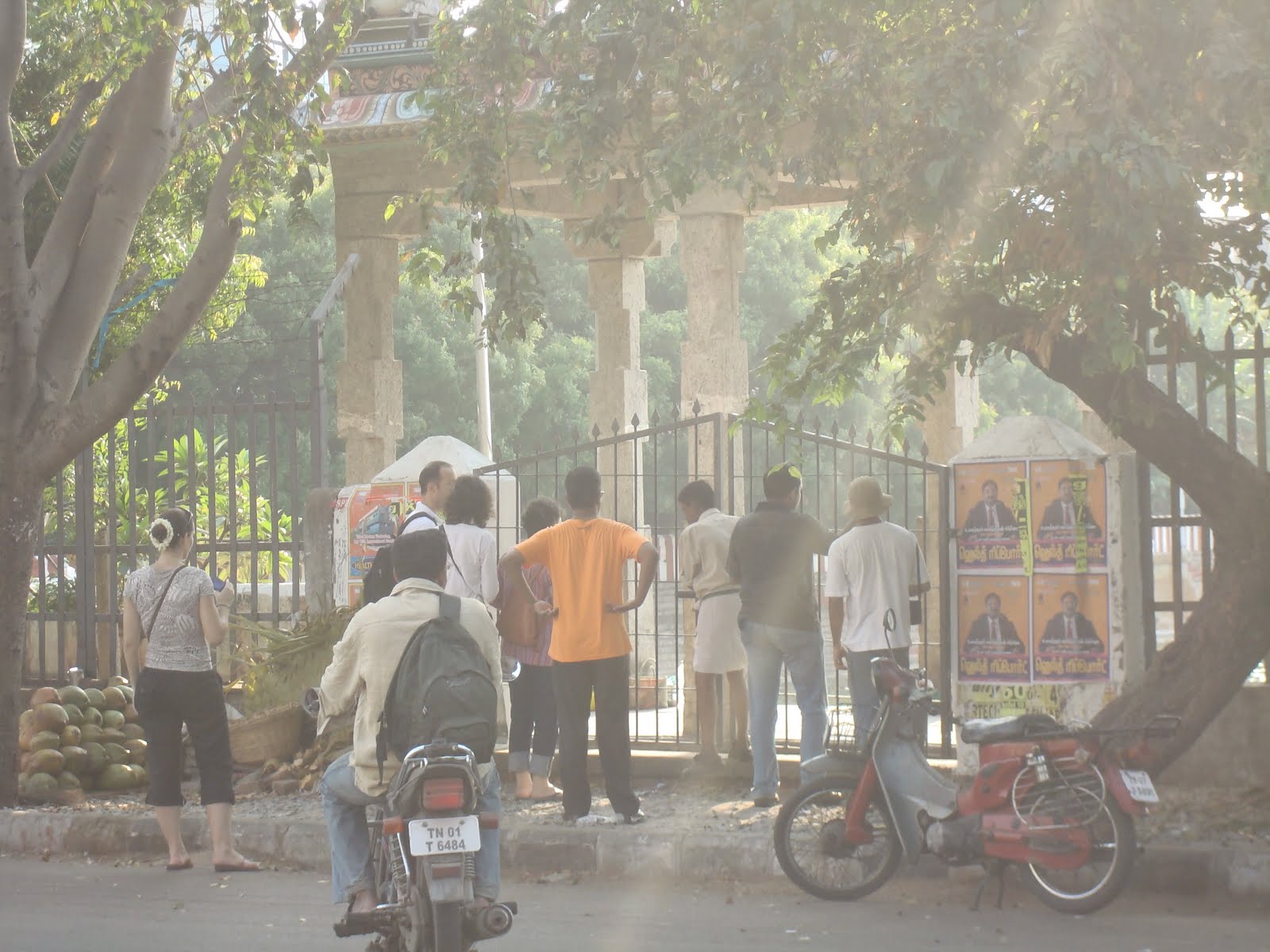
The Kapaleeshwarar temple tank is a very soothing sight in the early light of day. A sight that's tempting enough to draw the passer-by to get close to the waters and rest a while. But it is also considered a holy tank and access is therefore restricted at points other than the temple's entrance.

An unlocked gate was tempting a few tourists to try and get in, but they were observed very soon - and the gate promptly locked up!


Saturday, 6 March 2010

Half-a-dozen names

Founded in 1869 by the Maharaja of Vizianagaram and funded by Sir P.S.Sivaswami Ayyar sometime in 1918, this school has gone through five names and is currently on its sixth. It is quite likely this name would not be changed and the school will continue to be known by its current name - Lady Sivaswami Ayyar Girls' Higher Secondary School.

Some say that Sir Sivaswami Ayyar sold his house to finance this school; there doesn't seem to be any direct link between the one and the other. However, it does appear that the money he bequeathed to this school came, at least in part, from the proceeds of selling his bungalow, Sudharma, to the Amalgamations group.

The names this school has carried over the last 140 years reflect its benefactors - the Maharaja of Vizianagaram initially and then, the name of the Society which has been in charge of running this school - The National Boys' and Girls' Education Society, Mylapore. It is only after Sir Sivaswami Ayyar's death in 1946 that the school was named after his wife - a name that has now lasted for 64 years with just a minor change!


Monday, 1 February 2010

A decade of the festival

The Mylapore Festival can justifiably claim to have inspired at least two other public celebrations, the Madras Day/Week and the Chennai Sangamam. The former is, of course, coordinated by the folks at the Mylapore Times, the same people who run the Mylapore Festival also.

While the newer events are run on a much wider scale, the Mylapore Festival retains the charm of a neighbourhood mela. As the website says, it has grown from being a kolam contest to a 30-event, 4-day festival - and yet, retains the spirit of a small village fête, where everyone knows everyone else!


Monday, 25 January 2010

Story listener

This temple to Hanuman is one that's not terribly old. Not that it is a spring chicken, but it's age does not run into multiple centuries, or even one, for that matter. It was constructed some time between 1930 and 1950 and was probably intended to cater to the traders and workers who frequented the nearby Thaneer Thurai market. It is said that the idol of Veera Anjaneya, the presiding deity of this temple was placed in such a way that when viewed from the street, it seems to be on its way to the market. Whether that was really the intention, or is it just chance that set the idol in that direction is a matter of conjecture, rather than fact.

In its early days, it must have been quite a popular temple. It was to this temple that Rajaji brought the manuscript of his interpretation of the Ramayana after he finished it, circa 1956. Between reading the manuscript and listening to discourses on the Ramayana from the nearby Sanskrit college, this Hanuman would have had his fill of Sri Rama's story!

Sunday, 24 January 2010

Traditional, version 2.0

The Mylai Sri Karpagambal Mess is back in action after having been completely knocked down and re-built. It will take a while - quite a while - for this building to get that worn-out, we're-too-busy-to-think-about-painting-this look that its predecessor had. But inside, not too much seems to have changed. As it used to be, there are packets of various kinds at the entrance, and the serving staff seem to have stepped right out from the old building into the new. Just that with a little more light, we're able to see them more clearly than we're used to.

The Karpagambal Mess has always been one of those places which you could not be indifferent about. There are people who don't mind waiting for (what must seem like) hours to get a table, who make the pilgrimage to Mylapore only to eat at one of its tables. Then there are others who cannot stand the very mention of the name. The latter group, in most of the cases, comprises individuals who went in there with sky-high expectations about the Mess' much talked about adai-avial and badam-halwa ("melts in the mouth"). They did not anticipate having to deal with slow service and less than squeaky clean tables - so every little slip has been magnified and vilified quite disproportionately. With such strong, polarised views, it is rather difficult to take a middle-of-the-road approach to eating here.

As for me, I have no complaints about the times I've been here - in its earlier avatar or now. But then, I'd not be the first in a group to suggest we have a bite here, either!


Thursday, 21 January 2010

Worship is work

If you haven't been to the Kapaleeshwarar temple for a few years, you will be surprised to see how this establishment has grown - literally. What I remember as being a ground-and-first floor agraharam-kind of shop is now a three storeyed modern building. That's reflective of how Giri Trading Agency has itself grown, especially in the past decade or so. Considering they have been in Chennai for just about thirty-four years now, their growth has been quietly phenomenal.

The organisation is itself older, going back to the 1950s. But it began in Bombay, not in Madras, though it did have very strong Madras roots from the day it was born - or even before. Like many others of his generation, TVS Giri Iyer had moved from Madras to Bombay, looking for work. One day, he wanted to gift a friend's son a sandhya vandanam book for the boy's sacred thread ceremony. Not finding any such publication catering to the Madrasi's need for specific religious texts and puja material, Giri Iyer sensed a business opportunity. On his next visit to Madras, he bought several such books and started selling them at the Matunga railway station. It was certainly not roses all the way, but believing that he was on to a good thing, he had all his nine children help him with the business. The boys were based in Madras to source the material and transport them to Bombay, while the girls handled the sales and distribution there. In 1976, they opened a 200-square foot showroom right at the entrance to the Kapaleeshwarar temple.

That decision coincided with a rise in the demand cycle for religious items - and the nature of the items also began to diversify. Apart from the books, devotional music casettes began to rise in popularity. In the early 1980s, they began a separate division to cater to the music business. From that time on, there has been no looking back; with increasing global mobility, the demand for pre-packaged puja items and quasi-traditional merchandise like bharatanatyam costumes began to come in from around the world. Today, many of Giri Iyer's grandchildren are active in running the various businesses, through their showrooms as well as their online portal (where you can even download a religious ringtone for your mobile phone!). All those businesses add up to an annual turnover of around Rs.20 crores - all of which has grown from the Rs.300 worth of books that Giri Iyer took with him to Bombay!


Monday, 18 January 2010

Different, with similarities

It is said of us that we don't value history when it is all around us; like the villagers near the site of Harappa who did not realize the historic significance of the bricks from their village which were used as ballast by British railway engineers, many of us remain unaware of the history around us, just because it has always been around us. Add to it a tradition of transmitting information verbally rather than through any records and it becomes difficult to separate fact from legend.

The Madhava Perumal temple in Mylapore is steeped in legend. Depending on who you listen to, the temple goes back to the days of Vyasa - the 8th century BCE - or around 800 years, according to records available with the temple authorities. The four-pillared mandapam in front of the temple, which is a feature of Pallava temple construction, supports the latter estimate. For its age, the temple is quite well maintained, though not as crowded as one would expect given its antiquity and imbued holiness. In that aspect, it falls behind the Kapaleeshwarar temple, which is also of roughly similar stature.

Though the deities at the two temples are starkly different (Siva as Kapaleeswarar and Vishnu as Madhava Perumal), both of them have the same tree - the punnai (Calophyllum inophyllum) as the sthala vriksham (sacred tree)!

Saturday, 16 January 2010

Expensive pause

The first automated parking meters in Chennai came up sometime in October last year. Four of them were installed in Mylapore's North Mada Street, where parking has traditionally been quite haphazard. They haven't done away with the parking attendent completely, however. The idea with these meters is to pay the money for the duration you intend parking and leave that ticket on your vehicle's dashboard. The parking attendent's job is to make sure that all parked vehicles show off a valid ticket on their dashboards.

Theoretically, it is meant to tighten up cash collections and reduce the risk of parking attendants losing - or being robbed of - the fee they collect through the day. The Corporation hasn't yet released any results of how things have changed in the three months this system has been in operation at Mylapore, T.Nagar and Taramani, but I'm guessing they will not be in a hurry to rip these out and go back to the attendant-only system, which was being run by the Tamil Nadu Ex-servicemen Corporation (TEXCO). The firm supplying these parking meters is getting ready to install them at a dozen more locations.

One aspect that has gone almost unnoticed is that the parking fee has, from one perspective, gone up six-fold: earlier, TEXCO's authorised rate was Rs.5 for a maximum of six hours. It has now become Rs.5 for every hour - and you can park in one slot for only 3 hours at a stretch!

Thursday, 14 January 2010

Tall grass and stems

Over the past week, teeth have been strengthened thanks to a daily routine of tearing into the stalks of the tall grasses belonging to the genus Saccharum. No, it is not some new-fangled vegetarianism ritual, but just that it is Pongal time and sugarcanes have been coming in to the city markets.

The street side shops today had another non-regular item, besides the sugarcane stalks. You can make them out in the photo, just beyond the sugarcane display. Those are the turmeric rhizomes, still attached to the plant. Today, both the plant and its rhizome are put to use. Tradition has it that the mud-pot which is to be used for boiling the milk-rice mixture must be smeared with turmeric paste; sometimes a plant is tied to the pot after the cooking is done. The leaves of the turmeric plant are used to place some of the offerings.

Sugarcane sales this year have been dull in Chennai: some reports say that the city's demand has dropped by as much as 30% over last year. Maybe the ongoing uproar over sugar prices has something to do with that!

Wednesday, 13 January 2010

Of pins and irons

Somewhere between the full-fledged, automated dry-cleaners and the mobile iron-man on your street lies the group of laundry/iron-ers (?) called 'pinmen'. Here's one of them on R.K.Mutt Road.

I haven't been able to figure out why they should be called so, but 'pinmen' seems to be a common term in these parts. Any ideas?


Monday, 26 October 2009

Visually separated

Quite close to the 'old townhouses' of Mylapore is this building, which is actually quite distinct from the structures around it. It must have been a twin house at sometime, with one side being quite the mirror image of the other. Interestingly, both sides have space for commercial activity, though my guess is that those were originally meant to be enclosed car-parking spaces.

All other things being equal, the shops provide the distinction between the two residences. On the right is Joseph Store, a general store offering all kinds of provisions; on the left is Sri Vinayaka Auto Works. Maybe the residents thought this differentiation wasn't good enough, so they painted their portions - including the grills and bannisters - in different colours!

Thursday, 22 October 2009

Fork in the road

Maybe that's a shop in the building at the end of the road, with its wooden doors still shut below an awning which appears to be falling under the weight of the previous night's rain. Mundagakanni Amman Koil Street, from where this photo was taken, veers off to the right; the spur on the left is Nattu Subbarayan Street.

This is in Mylapore, very much part of Old Madras and yet, quite different from the streets of George Town. Indeed, these areas were populated much before George Town was. Predominantly revolving around religious activity, these bustle on these streets had God, rather than Mammon, in mind. These are streets where a new face is spotted quickly, and the residents wonder what the stranger is doing, walking their paths. Of course, they are not all that insular, what with many vehicles trying to take a quicker route to their destination through these back roads. But the pedestrian still invites curious glances.

Many of the buildings are over half-a-century old, but several have been refurbished and expanded to keep pace with modern day requirements. The building on the corner, however, seems to be just the way it always was!

Wednesday, 7 October 2009

Eco-decor

What's a festival without some decorations? Sure, there are a whole lot of 'ready-made', re-usable stuff available, but they somehow lack the charm of the just-made thoranams. One is used to seeing them fashioned from mango leaves - they'd last for days, the slightly thick leaves changing from their dark green to brownish, just before they are replaced by a new bunch of the festoons.

But for a change, here are thoranams made from tender leaves of the coconut palm - the kurutholai. The fronds are taken down before they are fully grown, so as to take full advantage of their flexibility. These are just one of the many designs that the kurutholai can be made into (here is another), but being tender, the festoons don't last for more than a day!

Sunday, 4 October 2009

Old townhouses

Old houses in Mylapore; more details in a while...


Tuesday, 29 September 2009

Fresh vegetables

This is a sight that's getting rarer by the day. Madras had large spaces for markets like these, dotting every part of the city. They were all built over 50 years ago and some are almost 100 years old. The Thaneer Thurai market is somewhere in between, and would fall somewhere into the 'medium-size' category for such markets. They're the last-but-one link in the traditional chain of getting vegetables from field to table within a day. (The last link? That's here!).


But such spaces in the middle of the city's commercial areas are too valuable to be left to such markets; many of them have given way to shopping malls or to multi-storied buildings. Roughly 40,000 sqft of space in the middle of Mylapore would send any property developer's heart pumping, so it is a wonder this market still survives.


Not for long, apparently. Many of the stalls in the Thaneer Thurai market are empty, having been vacated by legal proceedings. It is said that the space has been bought up by a large retail store and once they manage to have all the remaining vegetable vendors evicted, it will be curtains for the market!


Monday, 28 September 2009

Saint's temple

The man is venerated as a saint, but for all that, few people know that there is a temple dedicated to Thiruvalluvar within the city. And no, I'm not talking about Valluvar Kottam, which everyone knows about, but a 'proper' temple in Mylapore, where Valluvar is believed to have born, lived and died. The caretakers of this temple aver that Valluvar was born under an iluppai (mohwa, botanical name Madhuca - or Bassia - longifolia) tree that was fatally damaged in 1935, after having lived for over 2000 years, in this campus. The stump of that tree has been cemented around for much of its height, with a copper covering shielding the part above.

They also point out a well, claiming it to be the one from which Vasuki, Valluvar's wife, used to draw water for her household. Once, hearing her husband call out to her, she ran into the house, letting go of the rope with a vessel that she was hauling up from the well. Legend has it that the vessel remained in place until Vasuki returned - such was the power of Valluvar's word. Yet, it is said that he had to go to Madurai for his work to be recognized. That may be history or legend, but even today, it is at Kanyakumari - or even at the Kottam - that people pay homage to Valluvar, rather than this temple at his putative birthplace.

Given that the poet-saint's great work had very little to talk about God - or religion of any kind - it is somewhat surprising to see shrines of Hindu deities. Trying to balance both legend and faith, the temple ends up doing justice to neither!


Monday, 20 July 2009

Flower women

Why would you need to get to these ladies before setting out to San Francisco? Well, if you'd listened to the 1960s song by Scott Mckenzie, you'll remember that he had asked you to be sure to wear some flowers in your hair! It's something folks in south India have known for a long time, that flowers in your hair will make you a different person - the fragrance apart, there are numerous medicinal benefits they are supposed to bring along.

Time was when 3 mozhams (mozham = distance from the tip of the middle finger to the elbow; depending upon how naive you are, the elbow can either be its crook or the outside) were the norm for a woman to wear in her hair. These days, it seems like one mozham provides enough flower power for 10 ladies to jazz up their hair-dos, not that too many of the ladies seem to be wanting such jazz.

And yet, such sights are quite common around Chennai streets. To hedge their bets, though, many of the flower sellers stay close to a temple - if not for self, the flowers can be used for a higher power!

Wednesday, 8 July 2009

Make your own

Except for those 'No Parking' signs, the rest of the stuff is for sale. You can choose to create a temple in your own dwelling with these, or you can use them as props. That's your choice, of course!


  ©Chennai City Updates. Template byDLL Incorporation.

TOPO