Monday, 2 January 2012
Sunday, 2 October 2011
141, now
Posted byPackers Moversat07:450comments
Labels:Gandhi,Marina Beach,statue
Related Articles:Monday, 23 May 2011
The Rajah at the choultry
Posted byPackers Moversat09:3217comments
Related Articles:Tuesday, 17 May 2011
Looking another way
Tuesday, 10 May 2011
A man, a plan
And that was probably the last great sacrifice in Indian politics. Though Kamaraj was in his third term as Chief Minister, he still had considerable political clout in New Delhi, enough for Jawaharlal Nehru to take his advice in implementing what has come to be known as the "Kamaraj Plan". On the face of it, the plan was innocuous enough. Kamaraj proposed that senior leaders of the Congress should give up their positions in the government and move back to the party's organizational framework to revitalize the party. Kamaraj himself gave up his Chief Ministership under the plan, as did five other Chief Ministers and six members of the Union Cabinet. Kamaraj himself was almost immediately elected as President of the Congress Party. It was during his tenure that he orchestrated the transition through two Prime Ministers - Lal Bahadur Shastri after Nehru and then, Indira Gandhi after Shastri's untimely demise.
There are differing views on why the "Kamaraj Plan" was developed; some think it was to strengthen Indira Gandhi's position in the Congress Party. Others belive it was to push out Bakshi Ghulam Mohammed, the 'Prime Minister' of Jammu & Kashmir, who even though he was not a member of the Congress Party, offered his resignation - which was promptly accepted. Whatever be the compulsions for the Kamaraj Plan of 1963, the state unit of the Congress Party could do with some of Kamaraj's magic!
Monday, 8 November 2010
White man!
Well, I give up. He has lent his name to one of the better-known roads in Chennai (and also to a locality in Choolai), but I haven't been able to get much information about this man. It is said that he was the first Commissioner of the Corporation of Madras from the ICS - that steel frame of the Raj - but even with that lead, there does not seem to be much information available about this man.
Even his statue, in the main corridor of Ripon Building, where he once had his office, has been painted over so many times that his features have become rather difficult to discern. Just like the man himself, the statue also seems to blend into the wall - only the railing stops you from ignoring it altogether. Complete whitewash, I say!
Thursday, 26 August 2010
A saint's prayer
I went up St Thomas Mount for the first time as a child, quite a few moons ago. As I stood in front of this statue of Christ on the cross - I remember it as being completely white in those days - I was seized with the notion that we were at Golgotha; distances had little meaning and an hour's drive was as likely to take a child up to Mount Calvary as to that of St Thomas.
These days, there are two additional figures forming part of this tableau; while Pope John Paul II's statue is not seen in this picture, Mother Teresa (Blessed Teresa, now, isn't it?), to the right of Jesus, a bit of a way away, is shown in prayer. And it is to her this post is dedicated to, on the 100th anniversary of her birth!
Posted byPackers Moversat09:510comments
Labels:St. Thomas' Mount,statue
Related Articles:Wednesday, 11 August 2010
Birds of a feather
This is a fairly recent installation at the traffic signal near Foreshore Estate, one of a series on history and environment, which is expected to complete its roll-out over the next year. (To go with the folk arts / culture series that came up a year or so ago). It is said that the idea for this one came from the fact that, since the restoration of the Adayar Creek was taken up, the bird density in this area has gone up.
This installation shows a trio of sandpipers - only that they seem to be headed off in different directions at the signal!
Posted byPackers Moversat10:1025comments
Labels:Adayar,birdwatching,ecosystem,San Thome,statue
Related Articles:Saturday, 1 May 2010
Read this, please
Born as Kuppuswamy Iyer at Pattamadai, he went on to study medicine, which he practiced in Malaya as the head of an 'Estate Hospital' there. Struck with a feeling there was more to helping people than just curing illnesses, Kuppuswamy gave up his position and travelled to Rishikesh. By the time he was 40, Kuppuswamy had been Swami Sivananda for nearly 4 years. After a further decade of travelling around India as a wandering monk, Swami Sivananda established the Divine Life Society on the banks of the Ganga at Rishikesh. Since its founding in 1936, the Divine Life Society has grown both within and outside India.
On the occasion of his birth centenary in 1987, Madras city named a road after him, turning Adams Road into Swami Sivananda Salai. A statue of the saint was set up at the eastern end of the road, just where it joins Kamaraj Salai. Somehow, the statue seems to be of a roadside bookseller, pressing his wares on the passer-by. True, Swami Sivananda wrote close to 300 books, but he is to be remembered for much more than that.
At the western end of Swami Sivananda Salai, there was (is it there still?) a statue of Lord Ampthill, who was Governor of Madras between 1901 and 1906. I'm not sure if it was planned that way, or if it is just coincidence; one of Kuppuswamy's first forays into the public eye was in 1901, when, as a 14-year old, he sang a song to welcome the newly appointed Governor of Madras at the Kumarapuram railway station!
I'm back, on the monthly Theme Day for the City Daily Photo community. To see photos of statues from cities around the world, check this link out!
Sunday, 7 March 2010
Lonesome George
Under the pretext of easing traffic flow around the new Assembly complex being constructed on Mount Road, the magnificent statue of King Edward VII which was there has been carted away. Even more mindlessly, and shamefully, the statue of King George V near the War Memorial was also hacked off - both father and son are now covered in sackcloth and dumped somewhere on the grounds of the Government Museum. Sad.
The argument that the statues were reminders of the dark period of imperialism may have been valid at some time, but both Eddie and George had become part of the city's landscape over the years. If nothing else, the statues were much easier on the eye than several others that had come up at various street corners.
Now, the only statue of King George V that remains is the one on NSC Bose Road. Presumably, it has been left standing because it was put up by public demand and sponsored by Govindadoss Chatoorbhoojadoss, who was Sheriff of Madras in 1914 when this statue was unveiled. Today it stands alone - but keeping a watchful eye on all the vehicles around!
Posted byPackers Moversat06:430comments
Labels:King George,Museum,NSC Bose Road,statue
Related Articles:Thursday, 7 January 2010
Another with a name
As far as I have been able to figure out, there are only two flyovers in the city which have been named for someone. No prizes for guessing the first one - it was the first flyover in the city. Most people however continue to refer to it by the name of the locality where it is at - Gemini. That practice continued with the new flyovers which came up, whether it was on Peters Road, or at IIT. I am not sure if the officials thought of any other names for those flyovers, but none have been christened, officially. For some reason, this flyover, which opened about a year ago, was treated differently. It was named. There is only one reason why they named it what they did.
Over 40 years ago, in January 1969, a statue of 'Kalaivanar' N.S.Krishnan was unveiled at this junction and ruled over it from a traffic island at the centre. It was the last public function attended by Aringar Anna, the then Chief Minister - and a mentor, at least in their minds, to several present-day politicians in the state. Kalaivanar himself is also a much revered personage; such a combination bestowed the statue with a great deal of emotional value. The construction of the flyover meant the statue had to be removed. It was brought back though it is now to a side of G.N.Chetty Road, under the flyover. If that wasn't enough to soothe the statue's sentiments, the flyover was also named after N.S.Krishnan - it is called 'Kalaivanar Mempaalam' (Kalaivanar bridge/flyover) - thus becoming the second named flyover in the city.
There are rumours of the flyover on Cenotaph Road being named after Moopanar, but there has not been any announcement of that yet. If you still haven't figured out the name of the first one, it is simple enough. The one at Gemini is called 'Anna Mempaalam'. Well, you can try to argue that it is just an extension of Anna Salai on which it is located, but that wouldn't get you too far!
Posted byPackers Moversat08:380comments
Labels:flyover,GN Chetty Road,statue
Related Articles:Wednesday, 23 December 2009
Room under the stairs
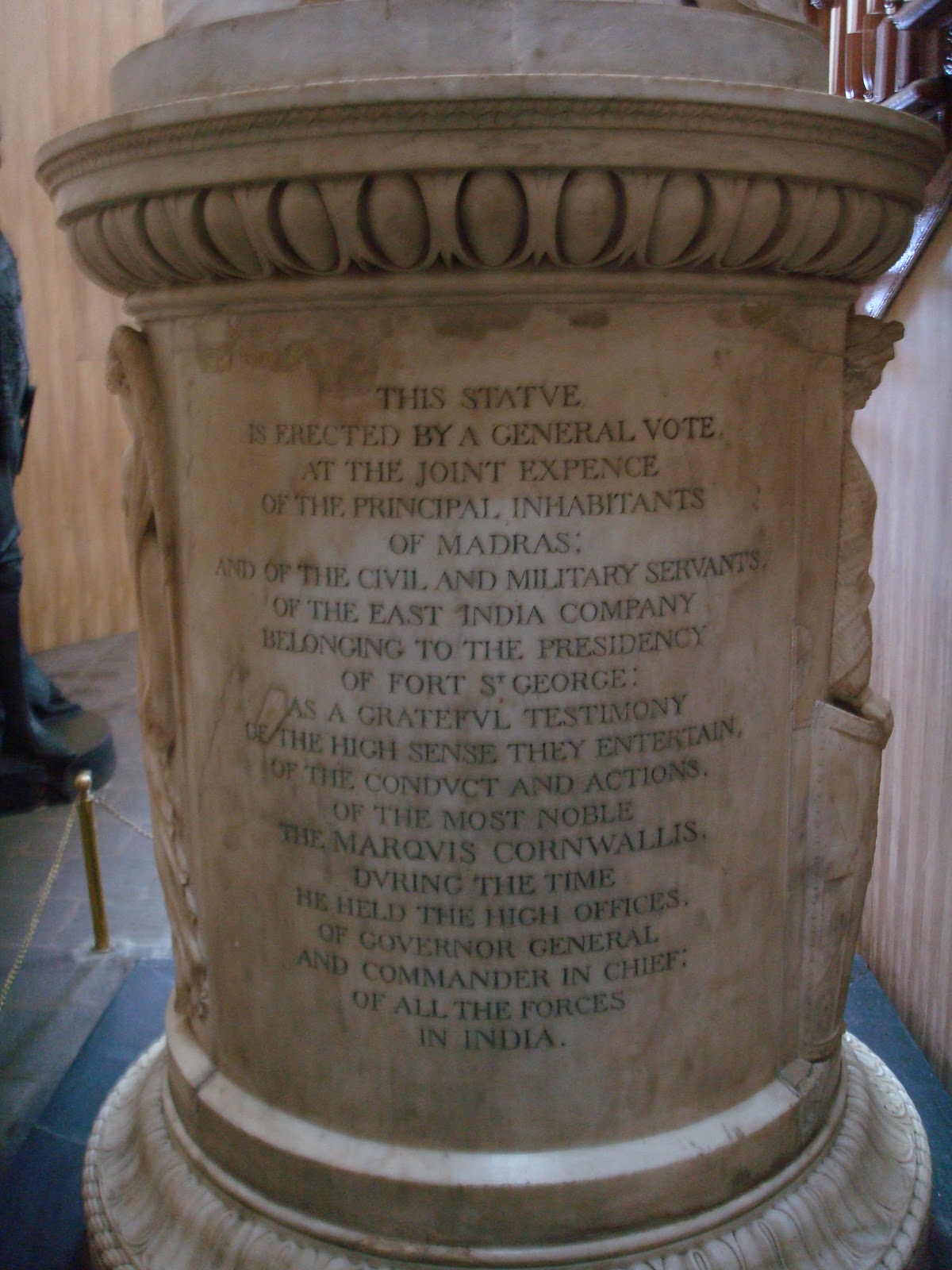
It was in 1793 that the "citizens of Madras", as represented by the Council in Madras, sent a letter to the President of the Royal Academy in London, expressing a desire to memorialize the military achievements of General Charles, the 1st Marquess Cornwallis. During his tenure as the Governor General of India between 1786 and 1793, Lord Cornwallis defeated Tipu Sultan in the 3rd Anglo-Mysore War. That was the crowning glory of his military career; a career that might have been consigned to the ashes when he surrendered to George Washington and Comte de Rochambeau after the siege of Yorktown in 1781. Luckily for him, King George III was favourably disposed to him and instead of being left in the cold, he was sent to India as the Governor General, where he redeemed himself in no small way.
And so the request from the Council at Madras, that the Royal Academy send them a statue executed under the "inspection of the Academy". The Academy assigned the task to Thomas Banks; the final sculpture, 14.5 feet tall, showing Cornwallis in all his lordly mien, standing upon a pedestal reached Madras sometime in 1800. One account has it that the statue was erected in Fort St George, while another says its first home was under a cupola at the junction of Mount Road and (today's) Cenotaph Road. That's a fine point, but the statue did spend time at that junction, which was when Cenotaph Road got its name.
The pedestal shows Tipu Sultan giving up his two sons as hostages, to be held until Tipu was able to pay the multi-million pound indemnity to win them back. Many thought this particular depiction was in poor taste (compounded by poor execution - the work on the base of the statue suffers greatly in comparison with the detailing of his Lordship) and that was probably one reason why the statue was moved to the Fort in 1906, overlooking the Parade Ground. In 1925, it was moved to the gates of Bentinck's Building, the then collectorate of Madras. That location was too close to the sea and the salt air did not agree with his Lordship. In 1928, he was moved to the Connemara Library and then, in 1950, he was moved to the newly purposed Fort Museum - and here, he only has room under the stairs!
Tuesday, 17 November 2009
The Soldiers Friend
St Mary's Church, inside Fort St George, is packed with memorials to British officers long gone. In almost all cases, the inscriptions on their memorials are lengthy enough to provide several clues to the officer's career and accomplishments. One of the few exceptions to this rule is this statue on whose pedestal it just says, "Conway - Adjutant General - Obiit 13th May 1837 / Erected by the Army and by the Public". That's most probably because there was quite simply too much to say about Thomas Henry Somerset Conway, who had served in India, "having never quitted the country", for the entire duration of his 44 years' service with the army.
It is also likely that he spent a vast majority of those years in Madras. A story tells of him, then a young Ensign beginning his career, looking out through a window of the Exchange House in Fort St George when he was tricked into believing that the House was on fire. Upon which Conway jumped out of the window and broke his leg, no doubt providing a lot of merriment to his brother Ensigns. From those early days in Madras, he went on to become the Adjutant General of Madras, a position he held for 28 years, under eight Commanders-in-Chief. During his service he covered almost every military campaign in south India, apart from seeing action in the Mahrattah War and serving on the Military Finance Committee at Calcutta. Unlucky with promotions, he remained a rung lower than his contemporaries, a circumstance that some attributed to his unrelenting discipline and rigid integrity (it is said that he died without leaving behind a shilling - for a British officer in early 19th century Madras, that's saying something!). Those qualities also gave him an unmatched understanding of "every thing relating to the dress, drill, appearance and discipline of an army".
Technically, he was the Brigadier at Hyderabad when he died. However, he hadn't yet formally assumed that post, for he died of cholera at Guntoor, en route to taking charge at Hyderabad; which is why this statue (by Turnouth) credits him as Adjutant General. Though he was absolutely strict as a disciplinarian, unwilling to distingush the human from the organization, he was held in high regard by the men who were under his command - and that's why, in small letters, right on top of the pedestal, it says "The Soldiers' Friend"!
Posted byPackers Moversat09:070comments
Labels:army,Fort St George,statue
Related Articles:Thursday, 10 September 2009
Follower, in a way
'Bharathidasan' is probably the smallest of the people whose statues are lined up along the Marina. Not in a physical sense, of course: some of the statues are of folks whose features have been shaped by imagination rather than data, but Bharatidasan suffers from a 'recency effect'. He died in 1964 which means many who have memories of him are still around to try and knock him off his pedestal once in a while.
Born in Pondicherry in 1891 and named Subburathinam by his parents, he came under the influence of Subramania Bharathi while in his teens. Bharathi mentored him in his early days and Subburathinam acknowledged that by changing his name to Bharatidasan (Follower of Bharathi). Mentee struck a slightly different path from mentor, being more fiercely protective of the Tamizh language against external influences as well as being an atheist, involving himself with the Dravidan political movement in the late 1940s and the 1950s. Though he had thrown himself into the independence movement earlier, he did not generate the reverence that his mentor did. Maybe that explains not only his political involvement, but also his search for an identity: he used several pseudonymns even as he continued to write as 'Bharathidasan'
And yet, the fact remains that when the World Tamil Conference was held in Madras in 1968, he was considered worthy of being placed alongside the greats of generations past - something that would probably make his the tallest of the statues along the Marina!
Posted byPackers Moversat10:170comments
Labels:Marina Beach,statue
Related Articles:Sunday, 30 August 2009
Fighters at the circle
This statue of kalaripayattu chekavars was installed at the Gemini Circle earlier this year, replacing the rather inconsequential piece which was loitering at this space. This statue is one of the six which were installed around the same time, each representing a cultural facet. While the other statues depict dances and staged performances, this is the only one showing off martial skills. Does the placing of this statue make any statement about the jostling for space around the Gemini Circle?
Sunday, 9 August 2009
The lady who might have been President
Maybe that's not a very 'Presidential' image in the photograph, but that's what the lady is best remembered for. Like many others, Rukmini Devi was transplanted to Madras when she was a two-year old, her father having been deeply influenced by the Theosophical Society's ideals. Thanks to that influence, Rukmini Devi was spared the experience of being married off even before reaching her teens, as was common practice in early 20th century India. Not that it mattered for too long; she shocked the conservative society of Madras by marrying Dr. George Arundale, twenty six years older than her, when she was just sixteen.
Her childhood years at the Theosophical Society left her with a lifelong love of nature and art; despite not being trained in dance as a child, something in her made the legendary ballerina, Anna Pavlova, suggest that she take up dance; after seven years of training, she gave her first public performance at the Theosophical Society's Diamond Jubilee in 1935. From then, there was no looking back; Kalakshetra, an institution dedicated to resuscitating artistic traditions of India, was established in 1936 (and has since grown to be recognized as an Institution of National Importance, in 1993).
Though she is best known for her dance performances - and her constant re-interpretation of the Bharatanatyam form - she was also an educationist, bringing in Dr. Maria Montessori to help set up the Besant Theosophical School (and setting up other schools later) and a champion of animal rights. She has been credited as being the motive force behind the legislation against animal abuse and the setting up of the Animal Welfare Board of India. That was only to be expected, for when she became a member of the Rajya Sabha in 1952, she reportedly said, "I should like to be the chosen representative of the tiger, the lion, the dog and the deer, the helpless and the voiceless". Maybe that's why when Morarji Desai sounded her out as a candidate for the President of India in 1977, she was lukewarm to the idea. Had she been more enthusiastic, the then Prime Minister might have pressed her case more strongly. But then, she may not have been able to spend as much time with the Kalakshetra Foundation as she did, almost until she passed away on February 23, 1986, just 6 days short of her 82 birthday. She will always be remembered as a unique individual, who bequeathed a unique institution to the city of Madras!
Posted byPackers Moversat06:590comments
Labels:Kalakshetra,landmark,statue
Related Articles:Thursday, 16 July 2009
George the second
That's not true, really. This is actually King Edward VII, father of King George V, the King Emperor. I did not realize that there are quite a few statues of this man the two kings, father and son, around Chennai - this is the second one such statue featuring on this blog (hence the title of this post! - the first one, of King George V, is here). I'm not sure if there is any significance to the placement of these statues, but it would be a reasonable guess that they were distributed in such a way that no matter what road one took to or from Fort St George, one would have to pass under the gaze of one of the monarchs!
Posted byPackers Moversat09:130comments
Labels:King George,Mount Road,statue
Related Articles:Friday, 19 June 2009
Roadside fire
Like many of the others on the Old Mahabalipuram Road (now called Rajiv Gandhi Salai), this installation too, does not have any description. This, however, is one of the easier ones to figure out; most of the descriptions - none official, though - call it 'The Flame'.
At the time of its installation, about 3 or 4 years ago, the roadside was rather barren; the white, orange and yellow of 'The Flame' kind of blended with the red-brown dirt of the roadside. But now, with the verge having become quite green, the colours of 'The Flame' sparkle against the green; with a couple of plants having grown tall enough to partially screen it, 'The Flame' plays peek-a-boo with its colours, allowing you to fully see them only from an angle on the road (of course, you can choose to park a bit of a way away and walk down to the patch around it).
Just goes to show that even a little roadside fire can grow on you!
Wednesday, 3 June 2009
Big man little man
An old photo, taken when work on the Kathipara grade separator was still going on; didn't notice the person behind Nehru's statue earlier - somehow it seems to underline how towering JN's presence had been. The statue itself was quite an eye-catcher at the roundabout. But now, the Big Man is stuck somewhere amidst the whorls of the flyover and nobody notices it these days... or do you?
Posted byPackers Moversat09:400comments
Labels:flyover,grade separator,Jawaharlal Nehru,Kathipara,statue
Related Articles:Tuesday, 10 March 2009
Centrepiece
The next time you go shopping around Panagal Park (preferably in the daytime), take out a few minutes to go into the Park itself. It may be a leap of faith for many of you, but you can take my word that Chennai's parks are much better maintained these days than they were a few years ago, so going into one is not really the test of courage (or foolishness) that it used to be.
If you walk inside a bit, you will see a clearing where stands a statue, rather reddish in colour, looking unkempt. The birds have had a free run on his turban and the detailing on his sherwani has been rubbed down, but his eyes look out with regal mien, disdainful of you standing under him, peering at the slab on the pedestal and trying to make out the letters on them. Not understanding the Telugu script - or not being able to read it because of the dirt of the ages, you surmise, quite reasonably, that it is the statue of the Raja of Panagal, after who the park is named.
But look closer. Then take a look at this other statue. With the Star of India at his side clearing all doubts, you will recognize this is Sir Pitty Theagaraya Chetty. In the locality that he has lent his name to, of which Panagal Park is but a part, the man's statue could have done with some more care!
Posted byPackers Moversat07:200comments
Labels:Panagal Park,statue,T.Nagar
Related Articles: