Powered by Blogger.
Showing posts with label Poonamallee High Road. Show all posts

Monday, 23 May 2011

The Rajah at the choultry

Were he alive today, he'd be getting on to his 170th birthday, which is what the Wikipedia entry on him seems to indicate. Rajah Sir Savalai Ramaswamy Mudaliar, KT CIE has been away from us for over a century, but during his time he was a big enough philanthropist for his name to be seen in several places over Chennai. People miss it because it is in a narrow band on the choultry. They miss it because the initials "R.S.R.M." in Government RSRM Lying-In Hospital in Royapuram means nothing to them. His place of burial in Kilpauk, where he once owned a vast stretch of land, is probably inaccessible now.

This statue, erected by his friends, is probably the only one in the city. The man who was given the title Rajah as a personal distinction - rather than as a hereditary keepsake - keeps a watch over one of his favourite gifts to the city from right inside it!


Sunday, 1 May 2011

Next clearance


It has been a long while since I had thought of a post-office. And here I am, thinking letters and mailboxes at least once a day over yesterday and today! Last afternoon, it was because my son wanted to post a letter from Sabarmati Ashram, Ahmedabad: they have a special cancellation for letters posted there and he wanted to send one to his school, just to have the postmark.

Today, it turns out that I have to look for a mailbox again, for a different kind of 'posting' - luckily, I had this picture, taken a couple of years ago, and that's turned out to be useful. This one is on Poonamallee High Road and is serviced by the Flowers Road Post Office - or, to use the technically correct status, the Flowers Road Sub-Office (Delivery).

I hope they will still go ahead and make the next clearance at 10.45 am tomorrow, as the window on the mailbox says!

 
It is 'Theme Day' over at the City Daily Photo portal. Click here to view thumbnails for all participants

Friday, 4 June 2010

Old school

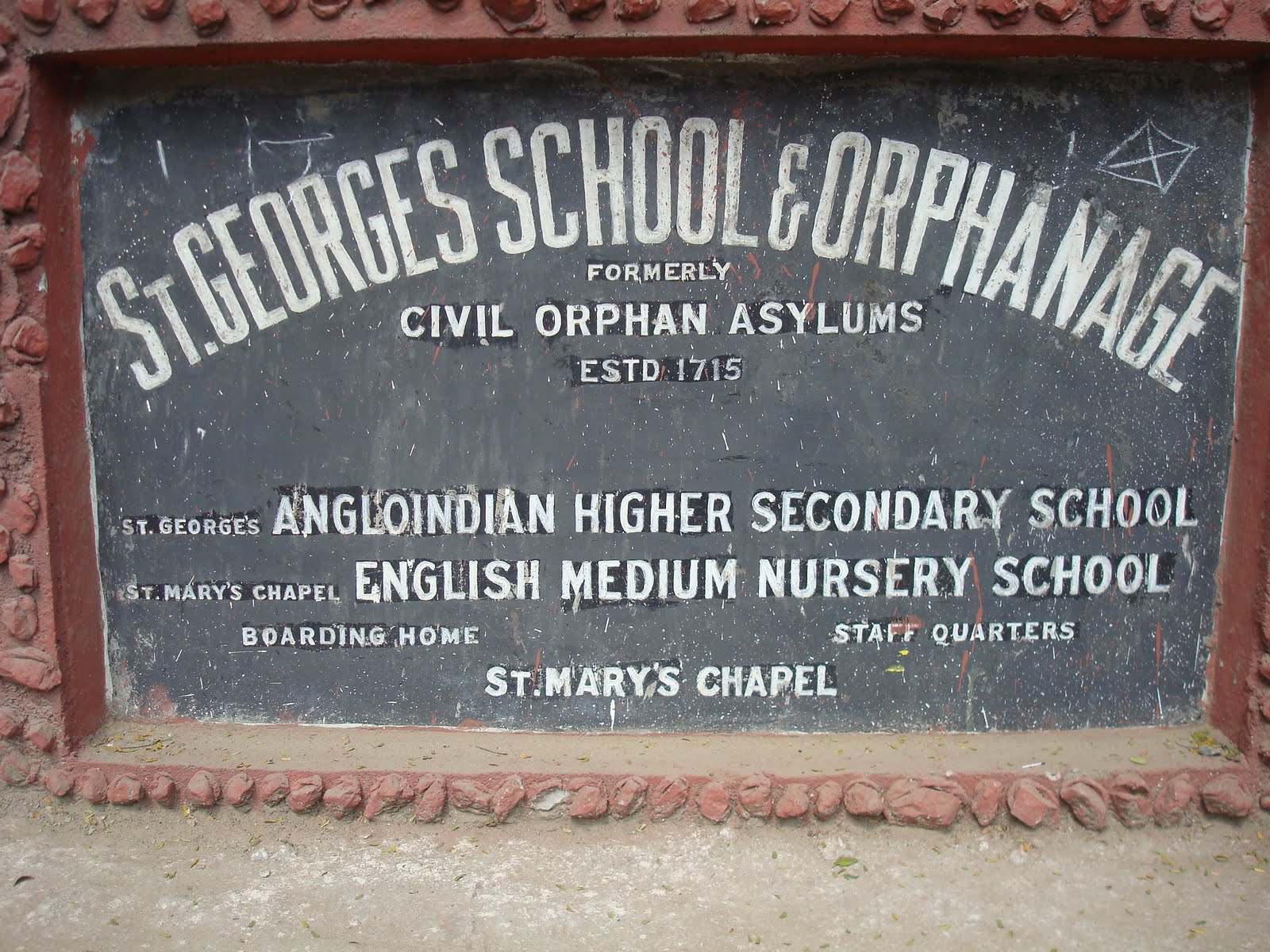
There isn't much that you need to say about a school that has been around for nearly 300 years, is there? If it is the St. George's School, there certainly is, because it is a very early instance of the Raj's 'Jewel in the Crown' giving back to the island. The school started from very humble beginnings; as a place for teaching military orphans, as well as soldiers' children, within St. Mary's Church in Fort St. George. Towards the end of the 18th century, it had grown to become the Madras Military Male Orphans' Asylum. In 1793, Rev. Dr. Andrew Bell, who was then in charge of the Asylum, persuaded the authorities to part with the premises of what used to be the Egmore Redoubt.

It was in this institution that Dr. Bell developed what became known as the Madras System of Education - essentially a mechanism where the senior students helped in teaching the junior classes - and formed the basis for today's 'teaching assistants'. The institution itself moved from the Egmore Redoubt, merging with the Female Orphans Asylum, which had by then occupied Conway Gardens (Conway of the "Soldiers' Friend" renown) on Poonamallee High Road. That move gave the Asylums vast premises and in 1954, they took upon themselves their current avatar as St. George's School & Orphanage.

Very few of the people entering its gates - the school grounds are a popular venue for large fairs, including the Book Fair - spare a glance for this sign and fewer yet are aware of how this school had contributed to a revolution in teaching in the Great Britain of the 1800s!


Wednesday, 3 March 2010

English chapel

This building, in the grounds of St George's School on Poonamallee High Road, was built between 1883-5 as the house of prayer for the girls who were housed in what was the Female Orphans Asylum. Mr. Muthiah, that venerable chronicler of Chennai that was Madras, calls it "a little church that is straight out of a picture postcard scene of rural English chapel".

That it certainly is, the 'Englishness' highlighted by the use of the Celtic cross; it is probably a nod to the fact that the Asylum had its origins in a charity school of the Church of England. The fish-scale tiles on the roof are also a style that is not very commonly seen in these parts - one other building that has it is also on Poonamallee High Road!

Monday, 16 November 2009

Still red, after all these years

The National AIDS Control Organization (NACO) has installed 11,025 Condom Vending Machines (CVM) across all metros and major cities in order to "provide anytime access to quality condoms in a non-embarrassing situation". By that objective, the CVMs have to be placed discreetly and therefore lack the in-your-face subtlety of the family planning advertisements of the 1970s.

Those advertisements could be seen everywhere - especially along the walls of houses and barns in the 'mofussil' areas. Showing a husband, wife and two children and the slogan "We two, ours two" (or local variants thereof), the ads would also have a large inverted red triangle. That triangle went on to become the generic logo of family planning programmes not just in India but also in several other countries. The man who is credited with coming up with that logo, Dharmendra Kumar (Deep) Tyagi, died childless at 41, before he could see the amazing recall his design provided the programmes. But his memory lives on in the name of one of the largest organizations providing subsidized condoms to many parts of the world - DKT International, founded in 1989 by Phil Harvey, who had worked with Deep Tyagi in the 1960s.

DKT International today is a key supplier to NACO; apart from the condoms, DKT International also provides support on distribution of contraceptive products, and for various community sensitising programmes across the country. Somehow, they seem to have got one thing wrong: red may have been the right colour for the inverted triangle, but when you want people to use something, shouldn't you be choosing a colour that invites them to go ahead?

Tuesday, 20 October 2009

Sky-high

A long time ago, one would look down into the forecourt of the Hotel Arun, when passing it on Poonamallee High Road. The first thing that the developers did after taking over the property was to raise it up to the road level. During the process, they also blocked part of the Cooum's bed; an act that sparked off some tensions and delayed progress on the mall they were developing.

It has now been almost a month since the first phase of the Ampa Skywalk has been opened; after nearly 4 years of waiting, folks are probably waiting for all the shops, the multiplex screens and the food court to come up before passing judgement on whether this is good enough to be a hip hangout. Big attraction - a walkway inside the mall, 80 feet above ground, which you will have to cross to watch movies at the PVR Cinemas (which I believe are yet to open).

It hasn't yet become so popular as to cause traffic pile-ups. Or did I pass by at the wrong time of the day?


Monday, 12 October 2009

Iron - not so old

The locomotive at the southern end of this building looks much bigger than its counterpart at the other end. However, this one does not seem to have the rambling history of the other one and seems to have served on just one sector, running between Bangalore and Bangarpet for all the 25 years it was in service. The Bangarpet-Bangalore line was put in place, in stages, by the Maharaja of Mysore as far back as 1918. Yelahanka, 16 km from Bangalore was at that time the homing shed for the locomotives working on this line.

This ZP-4 locomotive, manufactured by the Nippon Sharyo Seizo Kaisha in 1950 entered service on the Bangarpet-Bangalore line only in 1955. In 1980, the Bangalore-Yelahanka line was dismantled for gauge conversion. With that, this locomotive saw the end of its service and it was brought over to Madras, to be plinthed in front of the Southern Railway headquarters.


Friday, 25 September 2009

Old iron

Workhorse, it must have been. Lasted a long time, too. In service for 89 years, this steam locomotive manufactured in 1903 was one of the first built by Kerr Stuart & Co for railways in India. It was originally made for the Mayurbhanj State Railways (MSR), with the All India Number 691. When the MSR switched over to diesel locomotives, PL691 along with its 3 brother locomotives of the 0-6-4T class were moved from MSR to Parlakimedi Light Railway (PLR), which was also using locomotives of the same class. The PLR, which was being managed by the Bengal Nagpur Railway almost from its inception, became a part of the Indian government's portfolio when BNR was taken over in 1944.


Later, during the process of re-constituting the divisions of the Indian Railways, Locomotive PL691 moved to the South Eastern Railway division in 1955, after spending 3 years with the Eastern Railway. In 1987, PL691 had the honour of being featured on one of the 4 postage stamps released on the occasion of the South Eastern Railway's centenary year celebrations. It continued in service on the Naupada-Gunupur line until 1992, when the line was converted from steam to diesel. After its last run on April 23, 1992, PL691 was brought to Chennai and placed ("plinthed" is the correct term, apparently) in front of the Southern Railway headquarters building.


Four of its contemporaries (Nos. 692, 693, 694 and 697) have also been preserved. All of them have been plinthed outside various offices (then) of the South Eastern Railway: 692 at Puri and the others at Visakhapatnam. PL 691 alone, for some reason, has travelled all the way to Chennai - wonder what connection it had with the forerunners of the Southern Railway!


Thursday, 20 August 2009

Fork in the road

From the pedestrian overbridge near the Fort railway station, it is a wonderful view out to the south and the east. To the left, heading south-ish. is Muthuswamy Road, on which the present-day 'zero point' of Chennai is placed. That road will take you to Mount Road, or if you would like to get a bit of the sea breeze, all the way down to the War Memorial and then on to the Marina.

If you choose to go west, you get on to the General Hospital Road and the chance to pass by the Chennai Central - so if the fancy chooses you, you can exchange road for rail and reach a whole lot of places. If you ignore the Central's charms, you will head down Poonamallee High Road, eventually reaching Bengaluru.

Me, I'd just like to stand up here and watch the city!


Thursday, 13 August 2009

Waiting for the bus

Coming out of the Chennai Central railway station, a newcomer to the city is likely to be overwhelmed. The crowds, the traffic, the general hustle and bustle of a great city would make the newbie's head spin. If he has been properly advised though, all he would have to do to get some peace and quiet is to cross the road and get into the compound of the Ramasamy Mudeliar Choultry.

True, it is slightly difficult to spot the narrow gate of the Choultry. But once inside, the rush, the sounds, and even the smell of the city disappears. The passage opens to a large-ish courtyard; two or three lush trees give a sense of greenery which would have been unimaginable merely moments ago. From somewhere behind, the smell of woodsmoke chases away the stench of the city, forcing it to go out of the gate and back into Poonamallee High Road.

The bonus is, this is the place where TTDC's Hop-on Hop-off bus to Mamallapuram starts off from; what better way to begin that tour than by relaxing in the thick of the maddening crowd!


Friday, 7 August 2009

Headquarters

This building is somewhat of an oddity in Chennai's landscape. Where most of its predecessors and even contemporaries favoured the Indo-Saracenic style - and the red-brick exteriors which somehow seem synonymous with that style - the architect of this building, N.Grayson, opted for an adaptation of the Dravidian style. It is possible that Grayson, being a 'company architect', working for the Madras & Southern Mahratta Railway, was not influenced by the 'city architects' and chose to stick closer to his employer's requirements, rather than trying to blend with the city's other grand buildings. Samynada Pillai, the contractor, went with that design, but it took nine years and over Rs.30 lakhs before the building was inaugurated on December 11, 1922.

Today, this building houses the headquarters of the Southern Railways - the first railway zone to be formed on the Indian Railways, it was created by fusing together three large railway systems. The Madras & Southern Mahratta Railway, the Mysore State Railway and the South Indian Railway were the biggies operating railway lines in the south. With their integration, Madras became the headquarters of the Southern Railways and chose this building as its abode.

The central bay is flanked by two rectangular wings, both of which are arranged around a lush courtyard. Though built as office space, the building has large windows: long ago, those windows allowed the sea breeze to waft through, reaching the courtyard from the front and then going out through the wing opposite. I am not sure if modern airconditioning has shut all those windows down, making the building much less airy than it used to be!


Sunday, 26 July 2009

Forgotten gate

We normally keep complaining about how progress and modernisation has stripped away nature and greenery in the cities. But here's one example of how progress has rendered a certain highway obsolete and turned it back to a quiet path shaded by lots of green.

Today's Fort St George sees a tremendous amount of activity on its eastern side, with the secretariat, the Fort Museum and other offices being accessed from what were once upon a time the North and South Sea Gates. In the olden days, however, these gates were the minor entrances; even the long eastern wall of the Fort is not as thick as the ones on the other four sides. At the apex of this pentagon was St George's bastion, with walls thick enough to house a eating-place inside them. St George's bastion is flanked by the St George's Ravelin on the north and the Wallajah Ravelin on the south; the gates are also named after the ravelins. Wallajah Gate can still directly access Mount Road, as it has always been doing. St George's Gate - the most important one in those days, because it led directly out towards Poonamallee and the Nayaks - is today little used because the direct road has been cut off by railway tracks; even if you want to walk in that way, there are policemen who have instructions not to let anyone come in this way!


Wednesday, 22 July 2009

Flying doctor

Unlike Dr. Guruswamy Mudaliar, his contemporary, Dr. Sarukkai Rangachari often treated his patients for free. In fact, there are stories about how he gave a poor fisherwoman Rs.100 to take care of herself and her newborn child, and also how he once gave a boy a coin a day when he was down with typhoid. (That boy went on to become a famous neurosurgeon, incidentally). That kind of generosity coupled with 'rare medical skill and boundless humanity' made sure his clinic 'Kingston', on Poonamallee High Road was always full of patients. He would start his day at 4 am, performing varied surgeries until 11 am, followed by the in- and out-patient clinics, after which he would make house calls. Often, his lunch was had in his car, a luxury he defended by saying that he practically lived in the vehicle, and so allowed himself the privilege of making it a nice home.

One of his students, Lt Col Dr C.R. Krishnaswami, recalls that Dr. Rangachari was blessed with a wonderful constitution, that "from 1906, when he started, till his death in 1934, it was continuous, strenuous work of up to 18 hours a day for Dr. S. Rangachari." That constitution could not, however, stand up to the rigours he placed upon it during the typhoid breakout of 1934. Fighting hard against the sweep of the epidemic, Dr. Rangachari pushed himself to even longer hours, reaching out to more patients than anyone else thought possible. And so, when the disease struck the doctor, he succumbed to it, passing away at the height of his powers and popularity. The public of Madras subscribed to a statue in honour of this surgeon, which was unveiled by Lord Erskine, Governor of Madras, in 1939. That statue still stands near the exit gate of the General Hospital, shaded by a cupola, a couple of hundred meters away from that of Dr. Guruswamy Mudaliar.

There was another significant difference between the two contemporaries; where Dr. Guruswamy was frugal, Dr. Rangachari was outwardly lavish - apart from using a Rolls Royce to travel within the city, he had his own private aircraft (in the early 1920s) to make house calls in cities other than Madras!


Friday, 15 May 2009

West side entry

With the 'new' airport at Bengaluru being almost a two hour drive from the city centre, the number of people choosing to drive up, rather than fly, to Chennai would certainly have gone up. If you are one of those, you would be glad to see this toll booth because that's the last one on NH4 before you enter Chennai.

Unlike the one on the ECR (was that the first ever toll road in Chennai?), this one is managed by the National Highways Authority of India. The NH4 has always been a very significant road (not only because it connects Chennai to Poonamallee) for it is the road link to Bangalore and beyond that, all the way to Mumbai.

Even though I wasn't driving in all the way from Bangalore (I had gone only to Sriperumbudur), I was still glad to see this sign - it is back to the city!


Monday, 6 April 2009

Stable

There was a time when a hugh area in Madras was completely given over to the horses belonging to the Nawabs of Arcot. There were stables there, but those were only to lock the horses into - with the weather being pretty dry most of the time, the horses were often let loose inside the garden, without much fear of their catching a cold or anything. That garden of horses (ghoda-bagh) went on to become the Kodambakkam of modern times.

These stables in the picture do not threaten to go that way, mainly because there seem to be several takers for the services offered by these horses. Of course there is the regular baraat performance, needing the bridegroom to come in on a horse; then there are several themed parties needing the horses and carts to create just the right ambience - whatever it may be. You may have seen them, all spruced up, heading out for an evening's engagement very early in the day. In case you were wondering where these are coming from, look no more, for here's your answer!


Saturday, 4 April 2009

On a clear day, you can see...

Leading out of the northwestern gate of Fort St George is a long road; now a part of NH4, this must have been the most critical road in the early days of the Fort. It runs fair distance through the city and gets out through its western suburbs, heading out to the seat of the Nayaks, the governors of this region, administering the territory on behalf of their rulers. It was from these Nayaks that the grant of land where Fort St George would be built was obtained. More than a decade later, Nawab Mohammed Ali, who had seized control of all these areas from the Raja of Chandragiri, granted the British that town, the administrative headquarters of the Raja.

The road runs a reasonably straight course for most of its 23-km long distance to Poonamallee; but there are some kinks that cannot be straightned out. Like this one, at the junction of Poonamallee High Road and Raja Muthiah Road. Though it looks like it was taken from the middle of the road, it ws done standing on the pavement of Poonamallee High Road. And yes, on a clear day, you can see right up to the walls of the railway track near the Fort station from here... looking down the road from the other side with the sun at your back, you could probably see a long way, maybe all the way down to Poonamallee!

Saturday, 28 March 2009

From here to California

Shri Seetharama Rao firmly believed in the saying "we are what we eat". It was his endeavor therefore to move away from the more traditional choultry and sarai into hotels. His plank was to have hotels with a difference and the one he chose was to emphasize that this hotel would be completely vegetarian. In the 1920s, it was a novel concept, but Seetharama's bet that people wold love to have 'home food' without having to cook it was more or less spot on and so Hotel Dasaprakash became one of the happening hotspots of Madras in the '20s and '30s.

It was not just those times. Hotel Dasaprakash was active well into the first few years of this millennium, even though it had stopped being the favourite watering hole for the kind of people it used to attract in its early years - and even a while later. One can imagine the Freddie Threepwood kind of gentleman cutting up the rugs somewhere in this Art Deco building during the swinging sixties, but sometime after that, Hotel Dasaprakash became one more of those haunts for salesmen travelling on a budget, needing to keep up the appearances.

There are quite a few cars parked inside the gates. But the gates themselves have been shut for almost two years now, as the owners of the property try to make up thier minds about whose offer to accept for the building. There is little chance of Hotel Dasaprakash getting back to its glory days, for the new generation seems to have cashed in on the popularity of the brand - Hotel Dasaprakash has a property in Ooty and is also part of Bangalore's history - with the Dasaprakash restaurant in Santa Clara, California, USA. Maybe one day the brand will come back to its place of birth!

Thursday, 12 March 2009

Arriving hungry

Quick, which is the first eatery one sees on coming out from Chennai Central Station? If you answered "Buhari's", you are indeed a true Madrasi! They have been in Chennai since 1951 with their flagship restaurant on Mount Road. Not sure when the Central Buhari came up, but well, it has been around for as long as I can remember. Other hotels may have come up (and some gone, too), but Buhari is the place for that last biryani before getting into the unreserved coach to Jhumritalaiya or wherever!


Tuesday, 3 March 2009

Day ticket

A few weeks ago, there wasn't even one, and now there are two. First off the blocks was the Tamilnadu Tourism Development Corporation (TTDC), on Feb 20; five days later, the Villupuram division of the Tamilnadu State Transport Corporation (TNSTC) launched their version, though under the TTDC's banner. It must have been inspired by the Open Bus Tours, but they've thankfully stopped short of cutting off the tops of the buses - Chennai is never meant to be an Open Bus location!

TTDC's version is an hourly hop-on-hop-off sevice on the Chennai - Mamallapuram stretch. At Rs.150 for a day ticket, you can spend the whole day at various spots along the ECR. The TNSTC version, though, stays within the city and covers 16 places of interest within Chennai. Priced at Rs.250/- per day, it seems a good way to have a quick look around - even though the look is restricted largely to south Chennai. One hopes these hop-arounds will move to other parts of the city, too!


Saturday, 28 February 2009

The city's Sarai

Abdul Hakim was a reasonably wealthy businessman in Visharam, a town about 150 km west of Madras. He had inherited a successful hides and skins business from his father; bursting with ideas, he must have travelled to Madras many a time to do business with the leather buyers who came to George Town from Calcutta, Delhi, Bombay and the Punjab, not to mention the British, who were there for trading, anyway. The hides and skins business continued to be successful and Abdul Hakim, now with the suffix of Saheb, moved into public life through several charitable acts, largely directed towards education in his native Visharam. The Melvisharam Muslim Educational Society that he founded in 1918 continues to be active, most recently in setting up the C. Adbul Hakeem College of Engineering at Technology.

Influenced in some small way by his contemporary Rajah Sir Ramasamy Mudaliar, Hakim Saheb turned his attention to the traveller to Chennai and built a rest house near the Central Station, quite close to the Choultry built by the Rajah. So it was that bands of travellers to Madras in 1920 now had one more excellent facility to put up their feet and relax. Named after Hakim Saheb's father, Siddique Sarai has separate quarters for men and women, as well as a mosque for the men. The projecting balconies with their sloped shade keep the sunlight out and the traveller cool.

Unlike the choultry, the Sarai has been in continuous use since it was opened and is a shade better maintained than its neighbour!

  ©Chennai City Updates. Template byDLL Incorporation.

TOPO