Powered by Blogger.
Showing posts with label temple. Show all posts

Monday, 3 October 2011

Doll display

It coming close to the end of Navaratri; almost all over India, the 9-day worship of the mother Goddess in her various manifestations follows a similar pattern. But it is only in the southern states that the 9-step (or 7-step) display of dolls becomes a prominent feature of this festival. 


Here's a golu from the Kapaleeshwarar temple at Mylapore. Don't fret if you did not see it there yesterday; this picture is from last year's celebrations!


Tuesday, 31 May 2011

Faith!

Across the street from the gate of St. Peter's Church at Royapuram, is the Jamia Masjid mosque. The juxtaposition of the two symbols - the mosque's minaret and St. Peter's cross - make for an interesting picture!


Sunday, 29 May 2011

Temple in the crowd

As NSC Bose Road winds down through Sowcarpet, it gets ever more narrow until you wonder how two vehicles can ever pass each other by. Suddenly, you sense space. The road opens out just a bit and there you see this wall, the red-and-white stripes identifying it as part of a temple. From the peacock placed on the wall, you would guess the temple has to do with Subramanya - and you would be correct.

It is not a large temple, but considering the bustle of the area around it, the space is more than ample. The main deity is seen with his consorts, Valli and Devasena, the former's idol showing four arms - a rather unique representation of this Goddess. 

This temple is probably between 200 and 300 years old, going by the local stories. However, there are also stories that tell of Agastyar - whose image is also somewhere on the temple walls - having prayed to Subramanya in this temple. Well, you can choose what to believe!


Thursday, 26 May 2011

Tower, Anna Nagar

Probably not the one you were thinking of, right? The Masjid Javeed on 3rd Avenue, Anna Nagar, has a minar that is quite eye-catching, especially at twilight!


Friday, 20 May 2011

Parsi property

Down West Mada Church Road in Royapuram are several indicators of the city's Parsi heritage. The oldest of these indicators is probably this building, which stands on land that, by all accounts, was acquired by Heerjibhai Maneckji Kharas with five other Parsis sometime in the last decade of the 18th century. Just before that century ended, additional land had been leased for 99 years from the British East India Company. In 1858, with the Crown assuming sovereignty, the lands were transferred to the Parsi Panchayat.

In 1900, the Parsi Panchayat was renamed the Madras Parsi Zarthosti Anjuman. The property that had been leased from the British East India Company came to be referred to as Anjuman Bagh. Today, Anjuman Bagh houses within it a dharmsala for travellers, besides about fifteen flats though which the Anjuman provides subsidized housing for deserving senior citizens from the community. 

Though the original property on this road has been fragmented, the Anjuman Bagh continues to be a reminder of how the Parsis had contributed to Madras in large measure!


Sunday, 15 May 2011

The other church

It is natural that when one thinks of St Thomas' Mount and church in the same sentence, the building that comes to mind is the Church of Our Lady of Expectation. That's the one on top of the mount and perhaps the one that's much better known over the world. However, there is one other old church in the vicinity - one that goes by the rather workmanlike name of St Thomas Garrison Church. 

It was built sometime in the 1820s and was intended to serve as a place of worship for the garrisons stationed at St. Thomas' Mount and at Pallavaram. It is not clear why these garrisons could not go up the mount - probably it was difficult for the horses and carriages to climb up that winding path and so they had to have a church right at the foot of the hillock. Over the past two hundred years, this church has seen a lot, as can be gathered from all those memorial tablets inside. 

In the 1950s, when the Meenambakkam airport was getting ready for regular air traffic services, it was found that the spire of the St Thomas Garrison Church was impeding the flight path for aircraft landings. Ever since, it has had to do with this truncated top - the third storey and the spire had to be taken down to ensure aircraft safety!


Monday, 15 November 2010

Temple time

There is a story around how this temple was built by a Pakistani. How true is that story? I haven't heard it from any authentic source, if only because this temple predates the Pakistan nation by a couple of hundred years. Apparently there was someone from Lahore who was the man behind the construction of this temple, but the legend goes that the temple is about 200 years old.

The Bairagi Mutt is itself probably only slightly older. Although there are many shrines inside this complex, but the most prominent one is that of Lord Venkateswara and hence the name. As with quite a few other temples, while it is commonly called Bairagi Mutt, the full name of this temple is "Arulmigu Thiruvengadamudayan Venkatesa Perumal Thirukkoil". 

Bairagi Mutt will do, I guess!


Saturday, 7 August 2010

The hundred-year fire

It seems to be generally accepted that the first Parsis arrived in Madras sometime in 1795 and that they decided to stay on because the city afforded them many opportunities to turn their hand to business. In any case, Madras of the late 18th century was probably a melting pot of various nationalities and ethnic groups and so the Parsis would not have felt out of place in this great city. For a very long time, however, the Parsis did not have any formal place of worship; the major reason for this seems to be the inablity to find a priest who would settle in Madras. The Dar-e-Meher, or Fire Temple, houses the undying sacred flame that must be stoked five times a day by a priest. Without a priest, there seemed little point in building a temple.

The first permanent priest arrived in 1906. But the Dar-e-Meher itself took a while longer to come up. Parsi fire temples are of varied categories, graded by the sanctity of the fire within. The highest grade, the Atash Behram (Fire of Victory) is built by collecting fires from 16 different sources (caused by lightning, from a cremation, from furnaces operated for trade, from household hearths, and so on) and requires 32 priests to perform all the ceremonies involved in its consecration, which could take over a year to complete. At the other end is the Atash Dadgah, which could even be a lamp or a hearth over which the Yasna liturgy has been recited.

The Jal Phiroj Clubwala Dar-E-Meher is classified as an Atash Adaran (Fire of Fires), which is a combination of fires from four different sources representing four different working groups: priests, soldiers / statesmen, farmers and artisans. Named after the young son of Phiroj Clubwala, a prominent (and philanthropic) Parsi of Madras, the temple is built on land donated by him, upon which the grieving family had had this temple, designed and built by Hormusji Nowroji (another prominent Parsi of Madras) consecrated on August 7, 1910. Over the years, the monument has been the centre of their faith for the Parsis of Chennai and over the past week, they have come out strong in celebrating the centenary of the temple where the fire has been burning continuously for a hundred years, now!


Monday, 14 June 2010

No walking

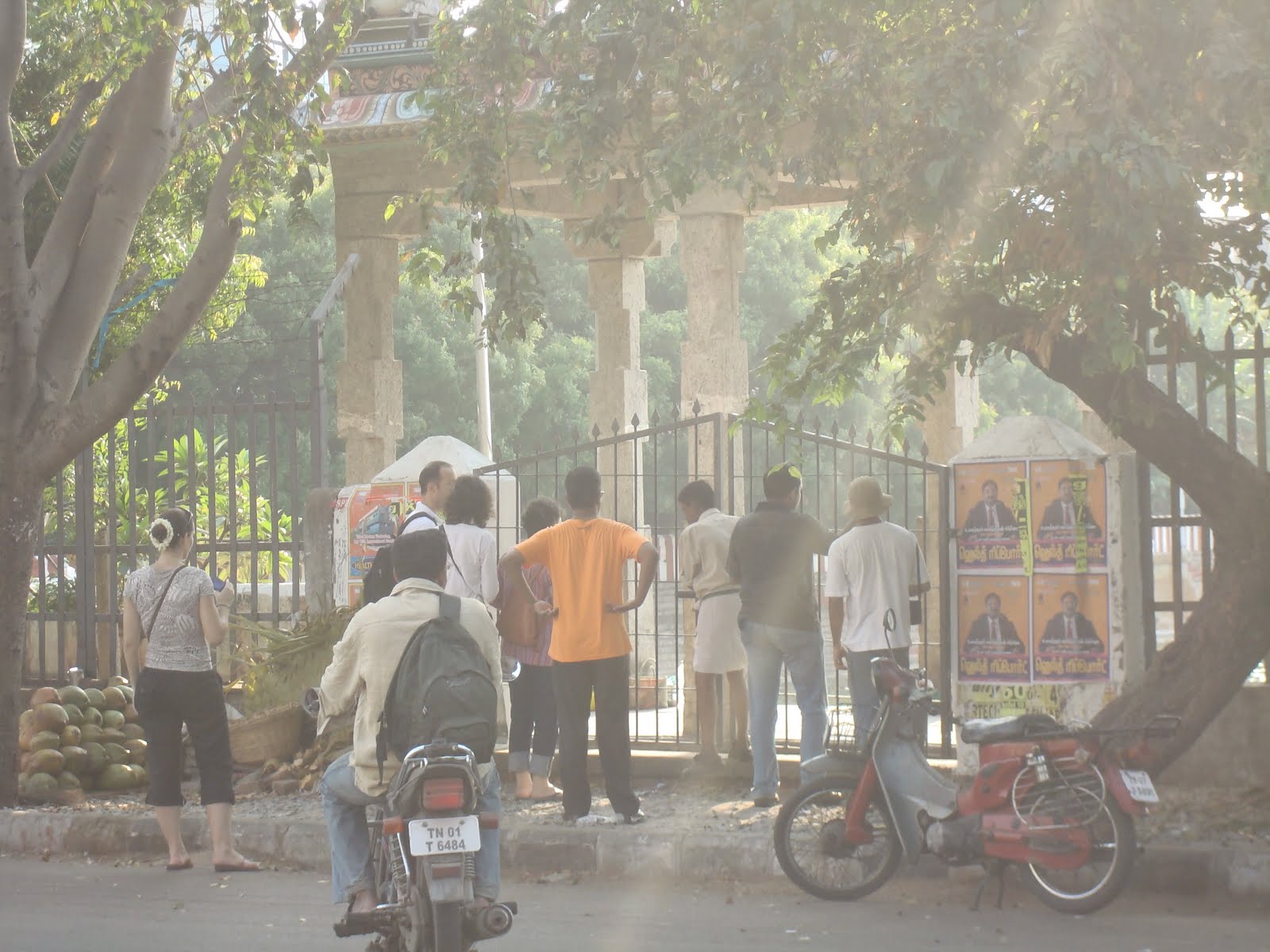
The Kapaleeshwarar temple tank is a very soothing sight in the early light of day. A sight that's tempting enough to draw the passer-by to get close to the waters and rest a while. But it is also considered a holy tank and access is therefore restricted at points other than the temple's entrance.

An unlocked gate was tempting a few tourists to try and get in, but they were observed very soon - and the gate promptly locked up!


Saturday, 5 June 2010

Combined temple

Of the Hindu pantheon's trinity, it is very rare, almost impossible, to find a temple to Brahma, the creator. And given a very marked division between those owing allegiance to Vishnu and those favouring Siva, it was very difficult to find a temple that allowed one to worship both these deities at the same time.
The earliest such temple in Chennai is in T.Nagar, close to the bus terminus. In fact, for a long time, it used to be the only such temple. Somewhere along the way, it became more economically viable for temples outside India to include all possible deities; temples at Lanham, MD, Livermore, CA and at several other places were all 'dual purpose' institutions. With that, there was probably more tolerance to such temples in India as well - Chennai itself now has at least three, if not more!

Tuesday, 18 May 2010

Mount Abu in Madras

Many believe that the best marble monument in India is not the Taj Mahal, but rather, the Dilwara Temples near Mount Abu in Rajasthan, sacred to Jains. It was from these temples that the Jains who had settled in Madras drew architectural inspiration from for their newer temple in the city.


Though the structure is new, worship at this particular site is not. The Chandra Prabhu Bhagawan Naya Jain Mandir, on Mint Street, was built at the same spot where one of Madras' oldest Jain temples, the Swetambar Jain Temple, stood. As with the other temples of the tirthankaras, the sanctum sanctorum is elevated from the ground level. Here, the main deity is Chandra Prabhu, the 8th tirthankara. Built largely of limestone, with accents in marble, it is both completely different (from the grey granite, or the gaily coloured gopurams) and similar (to other Jain temples everywhere).


Also, just as many other places of worship do, this temple also offers free food every day - only, in keeping with Jain traditions, the food is entirely free of spices, oil and even salt!


Monday, 22 March 2010

The 'Old Pagoda'

There is apprently a reference to this temple going back to 1652, but I have not been able to find that. However, James Talboys Wheeler, in his 'Madras in the Olden Time: 1702 - 1727' refers to a document "signed by President Baker, Agent Greenhill and Mr. Gurney dated in the year 1652", concerning the settlement of a dispute between the Right-Hand- and Left-Hand-Castes in the area north of Fort St George. That document names this temple as "Malley Carjun's old Pagoda", the use of the adjective supporting the claim that the temple is more than 500 years old.

Legends of the temple founding date it to between 800 and 1000 years ago: the discovery of a Siva lingam in the midst of a jasmine (malli) garden - apparently this area was thick with them - led to the construction of this temple. Today, the area is thick with various business establishments; many with tiny, one room offices, keeping the wheels of commerce moving through from the port to the city and beyond. In the midst of all that hubbub, the Mallikeswarar temple on Linghi Chetty Street is an oasis of serenity. In the past few years, the rajagopuram, built by a devotee in 1923 has been renovated and the teakwood temple car has also been restored; in 2008, the car went out on its festival run, after a gap of 58 years.

But if it is the 'Mallikeswarar' temple, how did it get corrupted as "Mally Carjun's Pagoda"? That's a riddle which will have to wait for another day!

Sunday, 21 March 2010

Navroj mubarak!

Today is the day of the vernal equinox; and a day when Parsis celebrate Navroj (or Navroze), their New Year. A very happy Navroj to Chennai's small population of Parsis (between 200 to 300 of them).

I'm sure they'll be celebrating this Navroj with more than the usual celebrations, for 2 reasons: firstly, because this is the first one after the UNESCO included Navroj on the List of the Intangible Cultural Heritage of Humanity in 2009 and secondly, closer home in Chennai, this year marks the centenary of the Jal Phiroj Clubwala Dar-e-Meher (the Fire Temple) of Chennai.

Here's a detail from that temple: Faravahar, a symbol reminding us that the purpose of life is to live in such a way that the soul progresses towards union with the supreme divinity!


Monday, 15 March 2010

Patron saint

In the early 18th century, a few families of Durgarayapatnam heard about the wonderful opportunities for boatmen who were ready to risk the surf at Madras and handle the ship to shore traffic for the traders. And so they came, to stay in the shadow of the new Fort St George, bringing in cargo and crew from the Madras Roads to the fort. Over the next few years, many of them turned to fishing, while other families joined them. By the 1740s, these seafaring people had thrown in their lot so much with the British that when the French took over Fort St George in 1746, the Chepauk community moved to Fort St David (at Cuddalore) with the British and then helped the British navy in their quest to re-possess Madras.

Fort St George's gratitude had a good memory; when changes were made in the way goods were delivered on the Madras shore, the fishermen - and other 'boat-people' had to move. To compensate for the move, Fort St George granted them about 45 acres of land further north of the fort. The fisherfolk moved there in 1799, built a church for St. Peter, their patron saint. In 1824, they decided that their church was to be re-built - the revised version was consecrated in 1829.

With the new church came disputes over ownership. It was only in 1867 that the Madras High Court handed it over to a board of trustees set up by ecclesiastical authorities. Since then, the church has been developed - the structure seen here is not so old, but the church itself has been around in some form or the other since 1799 - giving name to the area: Royapuram, for Rayappar, the Tamizh name for Peter!

Wednesday, 3 March 2010

English chapel

This building, in the grounds of St George's School on Poonamallee High Road, was built between 1883-5 as the house of prayer for the girls who were housed in what was the Female Orphans Asylum. Mr. Muthiah, that venerable chronicler of Chennai that was Madras, calls it "a little church that is straight out of a picture postcard scene of rural English chapel".

That it certainly is, the 'Englishness' highlighted by the use of the Celtic cross; it is probably a nod to the fact that the Asylum had its origins in a charity school of the Church of England. The fish-scale tiles on the roof are also a style that is not very commonly seen in these parts - one other building that has it is also on Poonamallee High Road!

Monday, 25 January 2010

Story listener

This temple to Hanuman is one that's not terribly old. Not that it is a spring chicken, but it's age does not run into multiple centuries, or even one, for that matter. It was constructed some time between 1930 and 1950 and was probably intended to cater to the traders and workers who frequented the nearby Thaneer Thurai market. It is said that the idol of Veera Anjaneya, the presiding deity of this temple was placed in such a way that when viewed from the street, it seems to be on its way to the market. Whether that was really the intention, or is it just chance that set the idol in that direction is a matter of conjecture, rather than fact.

In its early days, it must have been quite a popular temple. It was to this temple that Rajaji brought the manuscript of his interpretation of the Ramayana after he finished it, circa 1956. Between reading the manuscript and listening to discourses on the Ramayana from the nearby Sanskrit college, this Hanuman would have had his fill of Sri Rama's story!

Wednesday, 20 January 2010

An old chapel

In the early days of its occupation of Madras, the British East India Company was nervous about admitting British missionaries into their possessions. This was because they were worried about having to deal with maverick British traders entering the region pretending to be missionaries, but with the goal of breaking the Company's monopoly over the India-Britain trades. Believing they would have a free hand to punish imposters of other nationalities, they allowed French (Roman Catholic) and German (Protestant) missionaries to go about preaching to the natives.

That's how Benjamin Schultze, a German Lutheran, became the first Protestant missionary in Madras. Though he had come to Tranquebar (Tharangambady) in 1719, it was only in July 1726 that he arrived at Madras and began work in the 'Black Town' area outside Fort St George. Needing more space, he requested his employer, the Society for Promoting Christian Knowledge (SPCK) to buy up a garden house, where the Chennai Central Station stands today. That garden house was, in 1719, the subject of a petition by Antonio de Carvalho da Silva who claimed that it was bequeathed to her by her grandfather, Joao Pereira de Faria (John Pereira). The whole area around it was called John Pereira's Gardens, so there seemed to be some merit to her claim. Fort St George however, took a stand that their agent, Mr. Foxcroft, had in 1671 let the area to John Pereira to farm for 31 years and it belonged to them, even if they hadn't repossessed the place. Finally, the Council directed that John Pereira's Gardens be leased out for 11 years. Though the gardens had within them a tiled house and a sort of chapel near it, the property did not find too many takers, as it had fallen into disuse and had become a refuge for gamblers, who used the space for cock-fighting.

Probably the SPCK got it cheap at the end of that 11-year lease period. But they too did not take any interest in developing the property, most likely because it was outside the walls of the Fort and directly in the line of Hyder Ali's maurading armies. Even the building of a wall did not make the Garden any more desirable; the SPCK too seemed to have forgotten that they owned this property. It was only in 1826 that Rev. J.Ridsdale began to take an interest in this space and began work to construct a chapel - the older "...small Tyl'd house with a sort of Chappell..." having been destroyed during one of the many skirmishes of the previous century. The Trinity Chapel opened its doors to the public in 1831 - Rev. Ridsdale seems to have died soon after. Somewhere in all the furore, it is said, the chapel was never formally consecrated. No matter; for after all these years, it doesn't really need to be consecrated, does it?!


Monday, 18 January 2010

Different, with similarities

It is said of us that we don't value history when it is all around us; like the villagers near the site of Harappa who did not realize the historic significance of the bricks from their village which were used as ballast by British railway engineers, many of us remain unaware of the history around us, just because it has always been around us. Add to it a tradition of transmitting information verbally rather than through any records and it becomes difficult to separate fact from legend.

The Madhava Perumal temple in Mylapore is steeped in legend. Depending on who you listen to, the temple goes back to the days of Vyasa - the 8th century BCE - or around 800 years, according to records available with the temple authorities. The four-pillared mandapam in front of the temple, which is a feature of Pallava temple construction, supports the latter estimate. For its age, the temple is quite well maintained, though not as crowded as one would expect given its antiquity and imbued holiness. In that aspect, it falls behind the Kapaleeshwarar temple, which is also of roughly similar stature.

Though the deities at the two temples are starkly different (Siva as Kapaleeswarar and Vishnu as Madhava Perumal), both of them have the same tree - the punnai (Calophyllum inophyllum) as the sthala vriksham (sacred tree)!

Tuesday, 29 December 2009

The main devotee?

One of the occupational hazards of being a 'dubash' (from 'dvi' = 'two' and 'basha' = 'language') with the East India Company was having your name twisted around and being anglicized beyond local recognition. Resilient people they were, the dubashes took it all in their stride, comfortably straddling two worlds separated not just by language, but also by customs and cultures.


One such dubash was Alangatha Pillai, who was prominent enough to be one of the first 12 aldermen of the Corporation of Madras - he was named in the Charter itself. Apart from being a dubash, Alangatha Pillai, or Allingall as he was referred to by the British, was also the chief merchant of the British East India Company in Madras, coming to that position in 1680. Even in the days before he became the chief merchant, Alangatha Pillai had built up a good deal of coin with his dubash skills. Like many good folk, Alangatha Pillai deployed some of his earnings to religion. While he was likely generous in his donations to several temples, it is believed that Alangatha Pillai was specially fond of Ekambareswarar, the deity at Kanchipuram. He was a regular visitor to that shrine until the governor (was it Streynsham Master?) put it to him that if he were to build a temple near the Fort, a great deal of travel could be avoided*. Putting that idea to work, Alangatha Pillai had the Ekambareswarar temple built on what was then the Washers' Street.

However, there are other versions which claim that the temple has been in existence for over 500 years now, dating it to a time before the British. In which case, Alangatha Pillai probably financed the temple's renovation, endowing it richly from his personal fortune. Because of his munificence, the temple was marked in the official records as "Allingall's Pagoda"; that name did not catch on and the temple continues to be known as 'Chennai Arulmigu Ekambareswarar Temple'. There is, just as soon as one steps inside the temple, this carving on one of the pillars, showing a devotee. It is believed this represents Alangatha Pillai, the chief devotee at one time!


* A similar story is said about the Varadaraja Perumal temple at Kaladipet, but that'll have to wait for another post!

Thursday, 1 October 2009

Light on marble

The Jain Temple on Mint Street, Sowcarpet. More details in a while...


  ©Chennai City Updates. Template byDLL Incorporation.

TOPO