Monday, 2 January 2012
Saturday, 28 May 2011
General well-being
Posted byPackers Moversat09:260comments
Labels:Fort St George,hospital
Related Articles:Tuesday, 24 May 2011
Precious coral
The book "Diamonds and Coral: Anglo-Dutch Jews and Eighteenth-Century Trade", by Gedalia Yogev seems to have some fascinating accounts of the Jews of Madras, going by excerpts found here!
Wednesday, 17 March 2010
The second lighthouse
If you think the column in the foreground is a completely un-functional piece of work, you would probably be right. The major functional element of this column used to be what was on top of it; 120 feet above the ground was housed the arrangement of Argand Lamps and reflectors, supplied by Chance Brothers of Birmingham, flashing signals to the traffic on the Madras Roads.
Much taller than its predecessor on top of the Fort Museum, this Doric column lighthouse was designed by Capt J.E.Smith. It took about 6 years to build it and it became fully operational in 1844, although it was in intermittent use as early as 1841. The column was placed in the Esplanade, outside the walls of Fort St George. A photograph taken circa 1855 shows the lighthouse with its crown; a crown that was given up to the city's third lighthouse in 1894!
Posted byPackers Moversat07:580comments
Labels:Esplanade,Fort St George,lighthouse,Madras High Court
Related Articles:Thursday, 4 March 2010
Forgotten escape
Although the Japanese did not make too many serious efforts to attack Madras during World War II, the threat of air-raids was real enough for the city fathers to change the landscape and create an underground shelter. The Japanese did make an attempt, however. Some say that it was only a training run by a Mitsubishi Zero (or a Rufe, the Zero's seaplane version) which dropped a bomb near the Fort St George and then never came back.
Not much is known of the bombing; unlike the half-hour blitz by the S.M.S.Emden in 1914, which added the word emden (or emenden, if you like), meaning 'fearsome' to the Tamizh lexicon, the Japanese bombing seems to have been too mild to be remembered. Indeed, memories of the threat seem to have eclipsed the fact of its having happened. The official website of Chennai district lists it as a 'historical event', though with the rather dry entry, "1943 Japanese Fighter Plane dropped bombs on City and disappeared". A more tangible memory of that bombing is displayed in the Fort Museum - a fragment of the bomb itself, mounted on a brass plaque alongside a similar fragment from its 'illustrious' predecessor.
Another memory, though a tangential one, is the film 'Andha Naal' - the main character ('Sivaji' Ganesan), a traitor leaking secrets to the Japanese during World War II, being murdered on the night the Japanese bombed Madras!
Posted byPackers Moversat08:540comments
Labels:Chevalier Sivaji Ganesan,Fort St George,movies,Museum
Related Articles:Wednesday, 23 December 2009
Room under the stairs
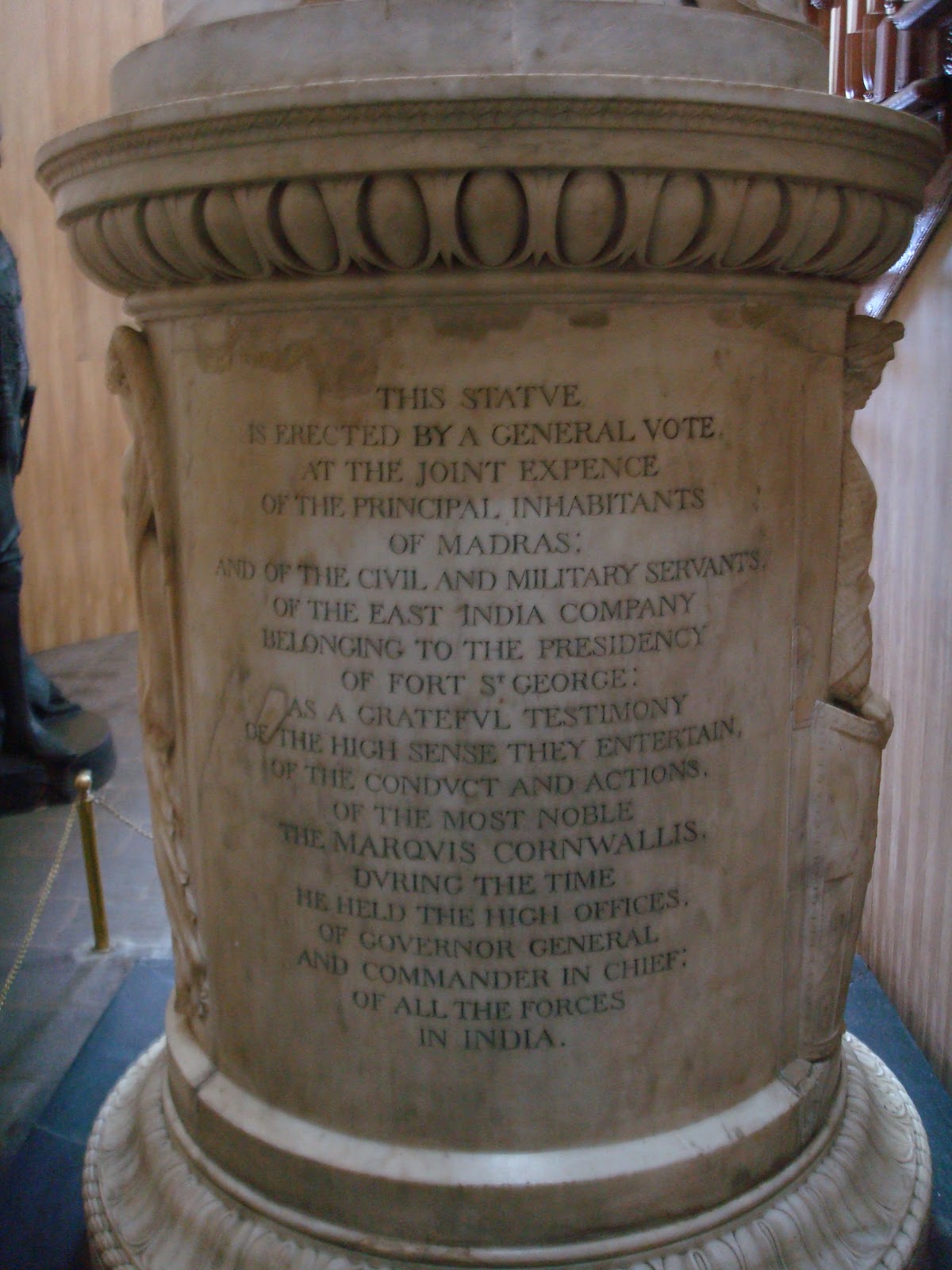
It was in 1793 that the "citizens of Madras", as represented by the Council in Madras, sent a letter to the President of the Royal Academy in London, expressing a desire to memorialize the military achievements of General Charles, the 1st Marquess Cornwallis. During his tenure as the Governor General of India between 1786 and 1793, Lord Cornwallis defeated Tipu Sultan in the 3rd Anglo-Mysore War. That was the crowning glory of his military career; a career that might have been consigned to the ashes when he surrendered to George Washington and Comte de Rochambeau after the siege of Yorktown in 1781. Luckily for him, King George III was favourably disposed to him and instead of being left in the cold, he was sent to India as the Governor General, where he redeemed himself in no small way.
And so the request from the Council at Madras, that the Royal Academy send them a statue executed under the "inspection of the Academy". The Academy assigned the task to Thomas Banks; the final sculpture, 14.5 feet tall, showing Cornwallis in all his lordly mien, standing upon a pedestal reached Madras sometime in 1800. One account has it that the statue was erected in Fort St George, while another says its first home was under a cupola at the junction of Mount Road and (today's) Cenotaph Road. That's a fine point, but the statue did spend time at that junction, which was when Cenotaph Road got its name.
The pedestal shows Tipu Sultan giving up his two sons as hostages, to be held until Tipu was able to pay the multi-million pound indemnity to win them back. Many thought this particular depiction was in poor taste (compounded by poor execution - the work on the base of the statue suffers greatly in comparison with the detailing of his Lordship) and that was probably one reason why the statue was moved to the Fort in 1906, overlooking the Parade Ground. In 1925, it was moved to the gates of Bentinck's Building, the then collectorate of Madras. That location was too close to the sea and the salt air did not agree with his Lordship. In 1928, he was moved to the Connemara Library and then, in 1950, he was moved to the newly purposed Fort Museum - and here, he only has room under the stairs!
Tuesday, 17 November 2009
The Soldiers Friend
St Mary's Church, inside Fort St George, is packed with memorials to British officers long gone. In almost all cases, the inscriptions on their memorials are lengthy enough to provide several clues to the officer's career and accomplishments. One of the few exceptions to this rule is this statue on whose pedestal it just says, "Conway - Adjutant General - Obiit 13th May 1837 / Erected by the Army and by the Public". That's most probably because there was quite simply too much to say about Thomas Henry Somerset Conway, who had served in India, "having never quitted the country", for the entire duration of his 44 years' service with the army.
It is also likely that he spent a vast majority of those years in Madras. A story tells of him, then a young Ensign beginning his career, looking out through a window of the Exchange House in Fort St George when he was tricked into believing that the House was on fire. Upon which Conway jumped out of the window and broke his leg, no doubt providing a lot of merriment to his brother Ensigns. From those early days in Madras, he went on to become the Adjutant General of Madras, a position he held for 28 years, under eight Commanders-in-Chief. During his service he covered almost every military campaign in south India, apart from seeing action in the Mahrattah War and serving on the Military Finance Committee at Calcutta. Unlucky with promotions, he remained a rung lower than his contemporaries, a circumstance that some attributed to his unrelenting discipline and rigid integrity (it is said that he died without leaving behind a shilling - for a British officer in early 19th century Madras, that's saying something!). Those qualities also gave him an unmatched understanding of "every thing relating to the dress, drill, appearance and discipline of an army".
Technically, he was the Brigadier at Hyderabad when he died. However, he hadn't yet formally assumed that post, for he died of cholera at Guntoor, en route to taking charge at Hyderabad; which is why this statue (by Turnouth) credits him as Adjutant General. Though he was absolutely strict as a disciplinarian, unwilling to distingush the human from the organization, he was held in high regard by the men who were under his command - and that's why, in small letters, right on top of the pedestal, it says "The Soldiers' Friend"!
Posted byPackers Moversat09:070comments
Labels:army,Fort St George,statue
Related Articles:Thursday, 24 September 2009
Boys' Town
The concept of a "Boys' Town" was born in 1921 when Fr Edward Flanagan of Omaha, Nebraska, began to work towards building a boys' orphanage as a 'City of Little Men', emphasizing the development of socially useful skills which would help the inmates in making their livelihood once they had to leave the orphanage.
Since then, the model has been adopted by several institutions caring for orphaned children. The term has itself become so generic that there seem to be several Boys' Towns across cities, sometimes even within the same city. This one run by the YMCA near Fort St George is the oldest in Chennai, having had its origins as a Street Boys' Club. It was only in 1947, after the YMCA was given this space to provide accommodation for the children, that the Street Boys' Club came to be called Boys Town.
Today, the Boys Town provides secondary education for over 2000 children, followed by vocational training. That's apart from the orphanage services it provides. Hard to imagine so many of them in such a small space outside the Fort!
Posted byPackers Moversat10:440comments
Labels:Fort St George,YMCA
Related Articles:Sunday, 26 July 2009
Forgotten gate
We normally keep complaining about how progress and modernisation has stripped away nature and greenery in the cities. But here's one example of how progress has rendered a certain highway obsolete and turned it back to a quiet path shaded by lots of green.
Today's Fort St George sees a tremendous amount of activity on its eastern side, with the secretariat, the Fort Museum and other offices being accessed from what were once upon a time the North and South Sea Gates. In the olden days, however, these gates were the minor entrances; even the long eastern wall of the Fort is not as thick as the ones on the other four sides. At the apex of this pentagon was St George's bastion, with walls thick enough to house a eating-place inside them. St George's bastion is flanked by the St George's Ravelin on the north and the Wallajah Ravelin on the south; the gates are also named after the ravelins. Wallajah Gate can still directly access Mount Road, as it has always been doing. St George's Gate - the most important one in those days, because it led directly out towards Poonamallee and the Nayaks - is today little used because the direct road has been cut off by railway tracks; even if you want to walk in that way, there are policemen who have instructions not to let anyone come in this way!
Wednesday, 17 June 2009
Guarded entrance
What is it about Chennai's museums that get them to display armament outside? True, Chennai does have some kinds of martial traditions, but those do not really define the city. In fact, the armed forces would be fairly low on most people's list when they think about Chennai. And yet, the two major museums in the city are fronted by cannons (or mortars, if you insist).
You might remember one of those cannons outside the Government Museum - and here we have a couple of guns, on either side of the main door to the Fort Museum. There are a couple of other field guns, too, on the verandah. All these were apparently seized from his army after Tipu Sultan was defeated at Srirangapatnam in 1799 - and since Madras was the headquarters in those days, the spoils were brought back - and have remained here since!
Posted byPackers Moversat09:370comments
Labels:army,Fort St George,Museum
Related Articles:Monday, 4 May 2009
Parched throats
Sometimes, you just can't beat water as a quencher of thirst.
Chennai Metrowater has spruced up the polyethylene storage tanks which can be found by the roadside at several places. Normally these tanks are used to store water in areas which do not have piped water supply. This one, in front of Fort St George, however seems to be one that is meant for passers-by to slake their thirst.
With agni nakshatram ('fire-star') having started today, passers-by sure need it!
Posted byPackers Moversat09:530comments
Labels:Fort St George,Metrowater
Related Articles:Friday, 1 May 2009
Take shelter
The Metropolitan Transport Corporation may operate the city's bus services, but if you want to catch one, you'll have to take shade at the mercy of the Corporation of Chennai. At the last count, there were approximately 1,200 bus shelters across the city. Many of them are in an advanced state of disrepair, the cement seats crumbling, as the are pillars. Others are designed rather poorly, that is not possible for them to be used as waiting spaces.
A couple of years ago, the Corporation of Chennai embarked on an ambitious project of upgraing the bus shelters. The idea was to form some kine of Public-Private-Partnership where a large enough proportion of the revenue goes back to the partner who has enhanced the look of the bus shelter. About 350 such shelters were identified; the modified design included cc tv, decent seats, a backlit panel, plus information panels showing the expcted time of the next bus and many other things which are essential for the commuters to know. The initial plan was to convert 350 of the existing shelters; it has been almost four years now, but it doesn't look like 350 bus stops have been upgraded.
The one in the picture certainly has been. Being right ouside the Secretariat of Tamil Nadu, it was probably one of the earliest to be upgraded. It appears that it is being used very sparingly; nobody wants to be the focus of attention from the ministers who look across to this bus shelter as their vehicle leaves the gate of the Fort!
Friday, 24 April 2009
Start of the Road
There was a time, until even about 70 years or so ago, when this used to be called 'The Mount Road'. That name came from the British era, but the throughfare existed much before that, passing along the sides of the villages of Chengalpattu, Pallavapuram, Mylapore, Egmore and all the way on to Tiruvottiyur. By the 17th century, this throughfare had also become the path for the Europeans - remember, the Portugese were here much before the British established themselves - to get to the site of St Thomas' martyrdom.
The British viewed the space around St Thomas' Mount as an ideal area for rest and recreation. That it had spiritual connections was an added advantage. The Council at Fort St George purchased a garden house at St Thomas' Mount as early as 1685 and it was put to use for sick and disabled soldiers to recuperate in. With that 'remote' outpost established, traffic from the Fort increased and 'The Road to the Mount' became an important one, leading out from the southwestern gate of the Fort.
Today, that gate is no longer in use. Mount Road comes in, rushing through the commercial areas, opening out just after Pallavan Salai to give the traveller a good view of Sir Thomas Munro seated, saddle-less, and then rushes over the Cooum before stopping abruptly at this point. And then turns away, suddenly losing itself into Muthuswamy Road (to its left) and Flagstaff Road!
Tuesday, 31 March 2009
One his own
He may have done several things in his life, but for Madras, Julian James Cotton's memory lives on in his work 'List of Inscriptions on Tombs or Monuments in Madras', a work that he published circa 1910. He had the weight of a huge legacy that he had to live up to; as seen on his tombstone, the three generations of Cottons before him had made their name and fortune in the services of the John Company. His great-grandfather, Sir Joseph Cotton, was a Director of the East India Company and his grandfather John went on to become Chairman of the Company. Sir Henry Cotton, his father, was a governor of Assam and, being a votary of India's right to self-rule, became president of the Indian National Congress.
Julian James does not seem to have inherited any of that derring-do. The thirty-four years he spent in the Indian Civil Service appear to have been without any deed worthy of a mention in the dispatches. Maybe his father's dalliance with the Indian independence movement cost Julian James his knighthood and also prospects of his career advancement. He seems to have spent all his time in and around Madras; joining the service in Madras in 1893, he remained there till his rather sudden death in 1927.
Julian James' son, however, inherited his ancestors' drive - born in Madras, Sir John Richard Cotton moved to England after his father's death, only to come back a few years later, after winning the Sword for Military History at Sandhurst, where he was also a Prize Cadet and King's India Cadet. With Sir John's death in 2002, five generations of the Cottons' serving the British soverign in Inda came to an end!
Posted byPackers Moversat09:230comments
Labels:Fort St George,landmark
Related Articles:Saturday, 21 March 2009
Door in the wall
Very nice, isn't it? 'Hotel Bindu' is not easy to find. It primarily serves the armymen based in Fort St George - and I am not sure if it is still in business, it does look as though the door hasn't been opened for a long while.
The hotel has walls that are at least a couple of feet thick, especially the wall opposite this door. They have to be, because the hotel is set in the outer walls of Fort St George!
Posted byPackers Moversat05:290comments
Labels:Fort St George,hotel,random
Related Articles:Wednesday, 4 February 2009
That's the limit
If you remember, the site of today's Dare House was, in 1758, the site from where Comte de Lally shelled Fort St George with his cannons. Today, it is not possible to see the Fort from there; but 250 years ago the only structures between the cannons and the Fort were the dwellings of the first 'Blacks Town' that had come up outside the north wall of the Fort. The cannons therefore had a pretty clear view of the Fort and pounded it with their fire. It is likely that the British were unable to retaliate - the Fort's guns, having to fire through the embrasures would have sent the cannonballs just over the houses of the Town, maybe even hitting some of the taller structures. That would have put them at a considerable disadvantage against the field cannons of the French, which could carve a parabola over the Town and into the Fort.
At least that seems to be the reason why the British decided to clear the area around the immediate vicinity of the Fort; it was now a major prize and had to be made unassailable. So, an esplanade was created, extending up to the point(s?) where de Lally's cannons were based (Sure, they did not account for technological advances...) and the new Blacks Town was created beyond those limits. A survey in 1772 fixed the boundaries of the esplanade by raising six obelisks, each rising about 20 feet high.
Only one remains; maintained by the Murugappa Group, it is painted in the same colour scheme as Dare House is; that is one reason why the passer-by will miss the inscription on the granite slab at its base, saying "Boundary of the Esplande, 1st January 1773"!
(click on picture to enlarge - the inscription can then be seen)
Posted byPackers Moversat06:270comments
Labels:Dare House,Fort St George,landmark
Related Articles:Sunday, 25 January 2009
Quieter music
After all the energetic music of yesterday, a quieter music for today. The organ at St Mary's Church, in Fort St George. More explanations will be filled in later!
Spent the whole day taking part in the Chennai Bird Race 2009; therefore this post is being written in pieces! What follows was written a while after posting the photo!
The church was completed in 1680, and it got its first organ seven years later. I am not sure if it is 'early' or 'late' for a church to get an organ seven years after its opening, but it was more by accident than by design that St. Mary's came by its first organ. In 1687, Curtana, an East Indiaman under Capt. Anthony Weltden was lying in the Madras Roads, in all likelihood on the way to the port of Mergui in Siam to deliver a message from King James II, ordering all Englishmen in the Siamese service to leave at once, ahead of military action against Siam. The Curtana must have had in its cargo a chuch organ, which was of little use in the martial mission it was undertaking. Capt. Walden offered to sell it to the Fort Council for 70 pagodas; the Council, recognizing that the organ was worth much more, decided to buy it for St. Mary's Church. It was a good bargain, for the instrument was well used - and probably well loved by the congregation, too, for the French took it away with them to Pondicherry after they occupied Fort St George in 1746 and Sir Eyre Coote went to the trouble of bringing it back to Madras in 1761 after defeating the French at Vandavasi.
It appears that St Mary's did not have an organ in the interim. The Curtana's organ was probably badly damaged during its transits to and from Pondicherry, so there was much back and forth between Madras and England on the matter of procuring a new organ, paying for the cost of the organ and for its shipping - the churchwardens were willing to pay the £300 price for the organ, but wanted the government to arrange for free passage for an organist to come to Madras. It is assumed that the government let this request remain in limbo and thus there was no organ playing in Madras for a long while. It was in 1859 that the church got its next organ, donated by Sir Adam Hay, in memory of his son, Capt. John Hay. Towards the end of the 19th century, the church commissioned William Hill & Son, of London to build an organ; and so, in 1894 the first organ, made exclusively for it was installed at St. Mary's.
That one has now lasted for 114 years; it has obviously had several restorations, the most recent one was by Cristopher Gray, completed in 2007. It is said that when Dr. Richard Marlow, Fellow of Trinity College, Cambridge played at the re-inauguration of the organ in 2007, St. Mary's Church was packed like never before!
Posted byPackers Moversat06:300comments
Labels:Fort St George,temple
Related Articles:Saturday, 10 January 2009
All the King's men
If you've been reading this regularly - or if you know your Chennai history - you will remember that the French under LaBourdonnais had captured Fort St George in 1746. In 1749, the French diplomats swapped Madras for Cape Breton, but the French garrison continued their attempts to capture Madras. Until LaBourdonnais, the British had not taken the French threat seriously, but after having been handed back Fort St George, they were in no mood to repeat their mistake and began to reinforce the battlements around.
At the same time, they began to expand the military force that was stationed in the Fort. Earlier intended as a trading location, the Fort now began to take on the nature of a military-commercial enterprise. With a greater number of soldiers coming in, there was a need to billet them properly; it was not possible for the houses in the Fort to be given over to them, nor was it feasible to build new houses for all of them. The solution was this: a vast building, covering over 10,000 square metres. The first to use it was the King's Regiment and so it came to be known as the King's Barracks, even though there is nothing regal about the building. Extremely plain and functional, it served its purpose of soldiers' housing for two centuries.
Today, it is still used by the army, largely as the canteen and cafeteria. Some of the living quarters are also in use, but large parts of the building are in poor repair and unfit for occupation.
Posted byPackers Moversat03:230comments
Labels:building,Fort St George
Related Articles:Wednesday, 3 December 2008
First, in a way
The Directors of the British East India Company were clear in their minds about the separation of the Church and the Firm. They were in it to make coin, not save souls and did not vex their minds too much about attending to the spiritual needs of their representatives in the newly created outpost at Madraspatnam. The honour of the first church in the Fort, therefore does not go to this building with the imposing spire. Yet, it has a first to its credit, being the oldest Anglican church east of the Suez.
In the late 17th century, the task of designing buildings often fell to gunners - maybe because they knew how a building could be destroyed, they could design one that could not be. In any case, William Dixon, the Chief Gunner of Fort St George was assigned to build the church. The money? Since the Company had refused to sanction any finances for such frivolity, construction of the church was funded by subscriptions from the 'locals'. Dixon was a gunner who knew his business, for St Mary's Church was consecrated in 1680, with a four-foot thick, dome shaped roof; one that withstood the cannonballs that de Lally threw at it from Parry's Corner during the siege of Madras in 1758. (The spire was added 200 years after the church was built, in 1884)
But that was much later; within a week of its consecration, the church recorded the first marriage, on November 4, 1680. The groom? A certain Elihu Yale, Esq., who is well known as the benefactor of that great academic institution!
Posted byPackers Moversat07:410comments
Labels:Fort St George,landmark,temple
Related Articles:Saturday, 1 November 2008
Not exactly Booker material
Another theme day for the City Daily Photo bloggers group goes by, without my realizing it. And I'm kicking myself, for the theme is something that I could have easily found something for. But didn't register, didn't have photos ready. If I had known, chances are I would have done something on the lines of what several others - including Eric, in Paris; Greg, in Hobart; Anu in Mumbai; 'BitingMidge' on the Sunshine Coast - had done. The pavement book sellers in Chennai are not the force they used to be, but they are still there, just the same. Many of them have shifted to pirated books, rather than the second-hand ones they used to trade in, quite a while ago. But that is material for another post.
Today, I'm just putting up this picture of the 'welcome page' in front of the Fort Museum. Merely walking around Fort St. George will provide material for a lot of books, if one could write them. The officers of the British East India Company did put a lot words on to paper - letters, diaries, bills, whatever, but there have been very few that have been strung together as narratives of life in the early Raj. There are a couple that I have found; In Old Madras, by B.M.Crocker, which has a lot of fiction, even about dates and places, but makes for a good read if you are in the mood. The Raj at the Table, by David Burton, on the other hand has little specific connection with Madras, but you can imagine the expatriates sitting down to 'homologated' breakfast, lunch and dinner!
Posted byPackers Moversat07:590comments
Labels:book,Fort St George,landmark
Related Articles: