Powered by Blogger.

Monday, 7 June 2010

Birthplace of 'Ob-Gyn'

INTACH's guide on Madras' architecture says the buildings are "Laid out in the shape of the female pelvis". Several sorties overhead on Google Maps does not show me any resemblance - no wonder I did not become an architect. There is however another story, of one of the early chiefs describing the building's layout in anatomical terms. Those flights of fancy are understandable, for the Government Hospital for Women and Children, (at first known as Lying-in Hospital) was the first specialised maternity hospital in India (and probably in Asia) and its early superintendents were doubtless eager to link that speciality with everything in sight.

Today, the hospital clocks around 18,000 births every year, but in its first year, it barely reached the three-figure mark. That was in 1844, when the hospital was situated nearer the River Cooum than it currently is. It was only in 1882 that the present buildings were occupied - thanks to the efforts of Sir Arthur Mudge Branfoot, KCIE, who was then a Surgeon of the Madras Medical Service. In 1921, the teaching block came up, named after Maj. Gen. G.G. Giffard, who had presided over the hospital's expansion between 1905 and 1917.

The hospital was also the birthplace of the Obstetric and Gynaecological Society of Southern India - and, in 1936 played host to the first ever national Ob-Gyn Congress, held at the Museum Theatre, just next door. With such an impressive heritage, it should be no surprise that the hospital boasts of a 120% bed-occupancy rate even today!

Saturday, 5 June 2010

Plains tea

Sitting in the Nilgiris, surrounded by a few tea plantations, it is tempting to write about how those bushes have changed the landscape of these hills. But somehow, tea plantations seem to be less of a problem in Ooty than those in Idukki, further southwest, in the neighbouring state of Kerala.

In the thick of those problems are the lands of the Kannan Devan Hills Plantations Company (KDHPC), over a thousand acres of which are to be taken over by the Kerala state government. That company was formed in 2005 when Tata Tea transferred / sold 25 of its estates in those hills to the employees and ex-employees of those estates, handing over roughly 57,000 acres in the process. But the state government claims those lands were never Tata Tea's to give away; the threat of an ordinance a few days ago is the latest in the ongoing tussle.

Looks like this board of M.S.Vel, on Armenian Street, identifying them as the agents for Kannan Devan tea will soon become redundant!

Combined temple

Of the Hindu pantheon's trinity, it is very rare, almost impossible, to find a temple to Brahma, the creator. And given a very marked division between those owing allegiance to Vishnu and those favouring Siva, it was very difficult to find a temple that allowed one to worship both these deities at the same time.
The earliest such temple in Chennai is in T.Nagar, close to the bus terminus. In fact, for a long time, it used to be the only such temple. Somewhere along the way, it became more economically viable for temples outside India to include all possible deities; temples at Lanham, MD, Livermore, CA and at several other places were all 'dual purpose' institutions. With that, there was probably more tolerance to such temples in India as well - Chennai itself now has at least three, if not more!

Friday, 4 June 2010

Old school

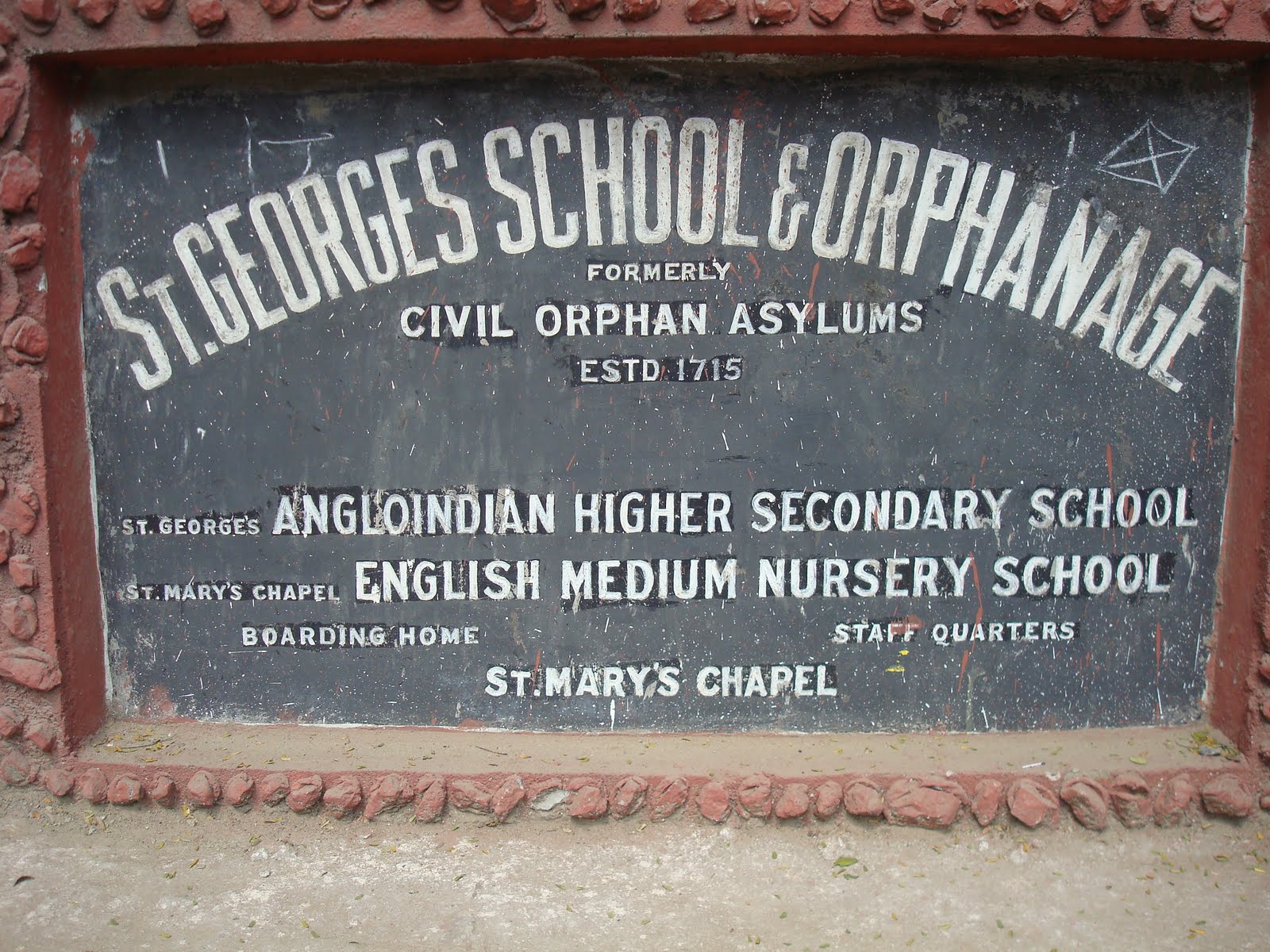
There isn't much that you need to say about a school that has been around for nearly 300 years, is there? If it is the St. George's School, there certainly is, because it is a very early instance of the Raj's 'Jewel in the Crown' giving back to the island. The school started from very humble beginnings; as a place for teaching military orphans, as well as soldiers' children, within St. Mary's Church in Fort St. George. Towards the end of the 18th century, it had grown to become the Madras Military Male Orphans' Asylum. In 1793, Rev. Dr. Andrew Bell, who was then in charge of the Asylum, persuaded the authorities to part with the premises of what used to be the Egmore Redoubt.

It was in this institution that Dr. Bell developed what became known as the Madras System of Education - essentially a mechanism where the senior students helped in teaching the junior classes - and formed the basis for today's 'teaching assistants'. The institution itself moved from the Egmore Redoubt, merging with the Female Orphans Asylum, which had by then occupied Conway Gardens (Conway of the "Soldiers' Friend" renown) on Poonamallee High Road. That move gave the Asylums vast premises and in 1954, they took upon themselves their current avatar as St. George's School & Orphanage.

Very few of the people entering its gates - the school grounds are a popular venue for large fairs, including the Book Fair - spare a glance for this sign and fewer yet are aware of how this school had contributed to a revolution in teaching in the Great Britain of the 1800s!


Thursday, 3 June 2010

Old terminal

It was on October 15, 1932 that the first commercial airline service began in India. Tata Sons had created its Aviation Department in July that year and it was JRD Tata himself who flew the first mail service, from Karachi to Bombay, landing on a grass strip at Juhu. That's pretty common knowledge. What is lesser known is that Bombay was merely a wayside stop on the journey; the de Havilland Puss Moth JRD flew was scheduled to take the mail from Karachi (now in Pakistan), all the way to Madras. The second leg, Bombay to Madras via Bellary, was piloted by Neville Vincent, an ex-RAF pilot and probably the nucleus of Tata's aviation foray. So it was that Madras added another first to its record, even if it was at the tail end of the schedule.

But many years before that, Madras was ahead by quite a nose. Giacomo d'Angelis, the Messinian hotelier of Madras, made the first ever flight in Asia. That was on March 10, 1910, when he flew an airplane of his own design, with the engine built by E & A Levetus & Co and Simpsons. That first flight was at Pallavaram, quite close to where Chennai's airport is today. Much, much later, Madras was again at the tail, being the final destination of Air India's first flight, from Bombay via Belgaum, in 1954.

For all those early records, and its current status as India's third busiest airport (after Mumbai and Delhi), Chennai airport still has a rather old-world charm to it. Not for it the miles of moving around the terminal buildings or not knowing which gate your flight is at. All that might change once the current modernisation effort is complete; however, that effort will surely spare this original terminal building which is now being used as the cargo complex!


Wednesday, 2 June 2010

Celebrating a century

Now that school leaving exam results are out, there will be a lot of activity around this building. Almost since the time it was established, in 1857, the University of Madras has been both a teaching and an affiliating university; in the latter capacity, it had under its fold all the engineering colleges that blossomed in Madras and the districts around during the 1980s. In 2001, it ceded its primacy in engineering education by transferring all those colleges to the Anna University and repositioning itself more as a research university.

When the University celebrated its centenary, it felt the need for a larger space than what was available in its Senate House, which, though spacious, had been taken over entirely by various administrative departments, leaving little space for grand ceremony. (Not to mention the feeling that the Senate House was too old for the modern age). And so came this building, the University Centenary Auditorium, with state of the art facilities; in the early 1960s, air-conditioning was quite rare and for a building such as this one, acoustical aesthetics were even rarer. On both these counts, a fair amount of thought went into the design. (The acoustics were written up as a research paper and published in 1968 by the Journal of Acoustic Society of America).

Even today, the UCA stays at the top of the list of choices for large functions; besides university convocations, the auditorium has hosted public shows, seminars, corporate functions and even movie awards in its 3,250-seater space!


Monday, 31 May 2010

Had a bite?

There was a sister sign to this one, extolling all the virtues of this antidote for scorpion 'bite'. This medicine only uses scorpions as a prop for striking up a conversation, for there is nothing it can't solve, World Peace included.

It is the Theme Day over at the CityDailyPhoto portal; I was thinking I should have saved up the one warning you about the lady of the house or the other one, about "Conditions Apply". This sign can't hold a candle to them in terms of mysteriousness, being very open and straightforward about what's on offer. Yet, it is a unique enough sign to qualify for the Theme Day!


Click here to view thumbnails for all participants

  ©Chennai City Updates. Template byDLL Incorporation.

TOPO